

How Does a Wake Word Detector Work?
- Basic
- Article
- Ages 14+
- 5 min read

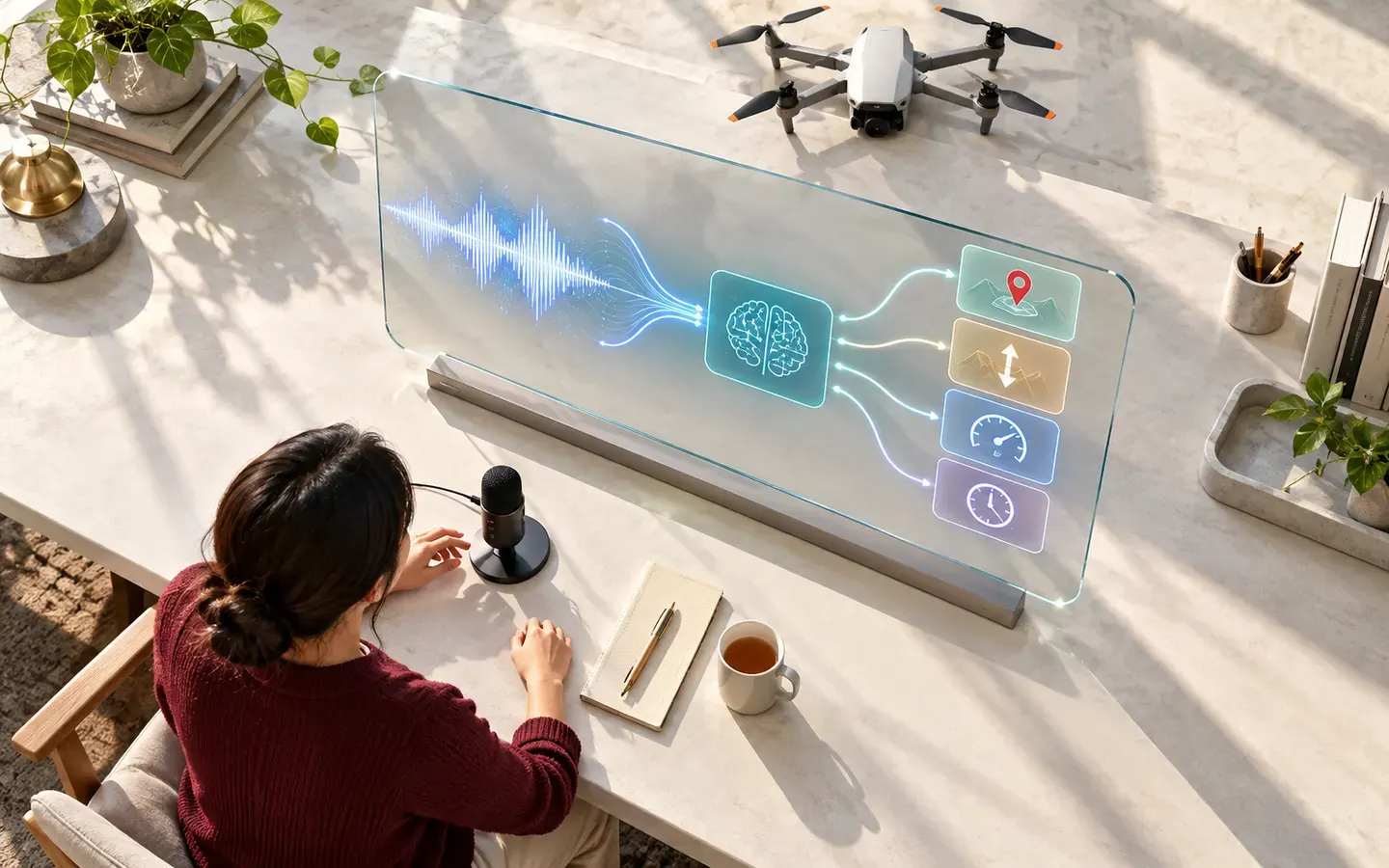
A wake word is a short phrase that tells a device to start listening for a command. The detector runs before full recognition, and one way to build it is audio classification: a model places each clip in a category and scores it by probability. Streaming recognition then gives interim results while audio is still being captured.
Contents
- Monitored audio
- Wake-word detection gate
- Command speech after activation
What you will learn
- Describe what an audio classifier does.
- State its output: categories with scores.
- Tell wake-word detection from streaming recognition.
Before you start
No drone experience is needed. New words are defined in the glossary.
How does an audio classifier work?
According to the MediaPipe Audio Classifier documentation, the task classifies audio clips into a predefined set of categories, such as guitar music, a train whistle or a bird song. The model runs on independent clips or a continuous stream and returns categories ranked by descending probability score.
What happens after the wake word is heard?
When speech must become text while the person is still talking, Cloud Speech-to-Text offers streaming recognition, which gives interim results as audio is captured.
Where are the limits?
The two documents describe a general audio classifier and streaming recognition. They give no specific wake-word model, false-alarm rate or recommended threshold. Measure the threshold yourself with recordings from the real environment.
A practical example
Hypothetical illustration, not an observed test result.
A demo device listens continuously with a classifier. When the score of the wake-word category passes a threshold the builder chose, the device opens a command window and only then switches to recognition.
Common misunderstandings
A high score means the user definitely said the wake word. The score is only a probability from the model; the threshold has to be chosen with real data.
Frequently asked questions
What does an audio classifier return?
A list of categories ranked by descending probability score.
Does it run on clips or a continuous stream?
Both: independent clips or a continuous stream.
When does streaming recognition give results?
Interim results arrive while the audio is still being captured.
Summary
- A classifier places audio into categories.
- The output is a list of categories with scores.
- Streaming recognition gives interim results.
Terms in this article
English and Vietnamese terms, with the meanings used here. Hover, tap or Tab to a term with a dotted underline for an explanation as you read.
- wake wordtừ khóa đánh thức
- A short phrase that tells a device to start listening for the next command.
- audio classifierbộ phân loại âm thanh
- A model that places an audio clip into one of a set of defined categories.
This article is not marked as viewed
Spotted something wrong or unsafe?
Tell the administrator by email. The message already has the article title and address.
You may also like
 Intermediate
How Are Intent and Parameters Extracted from Speech?
Trace a spoken sentence into intent, entities and normalized parameters, then handle missing or ambiguous fields.
Artificial intelligence6 min read Intermediate
How Do LLMs Turn Speech into Structured Commands?
Trace audio to transcript to model-proposed JSON, then validate its values before forwarding.
Artificial intelligence7 min read Intermediate
How Can a Drone Command Be Checked Before Execution?
Check a command from structure through current state, operator decision and the autopilot failsafe’s separate role.
Artificial intelligence7 min read Advanced
Simulating Drone Control with Voice Commands
Learn how voice commands pass through parsing, coordination, setpoints and feedback in a simulation, with evaluation criteria and failure cases.
Robotics8 min read


Sources
These sources are written for older readers. If they feel hard, read them with an adult.
- Audio Classifier(opens in a new tab)
Google AI EdgeTier C: other sourcesRead on October 30, 2026
- Cloud Speech-to-Text Overview(opens in a new tab)
Google CloudTier C: other sourcesRead on October 30, 2026