

What Are the Main Parts of a Multirotor Drone?
- Starter
- Article
- Ages 10+
- 4 min read

A multirotor drone is a system in which the frame holds the parts, the battery supplies energy, sensors describe the state, the controller calculates commands and motors turn propellers to create thrust. A common learning mistake is to memorize part names without tracing power and command paths. Following both paths shows what each part does.
Contents
- Airframe and four rotors
- Energy-supplying battery
- Camera as a payload
Main parts by role
| Part | Role | Main connection |
|---|---|---|
| Frame | Holds the battery, boards and motor assemblies in a stable relationship | Transfers loads and vibration between parts |
| Battery and power distribution | Supplies thrust and electronics branches; a power module may measure voltage/current | Battery → distribution board or wiring → ESCs and controller |
| Sensors | Measure motion, direction, altitude or position so software can estimate state | Data → driver → estimator on the flight controller |
| Flight controller | Runs the flight stack, estimates state and calculates control commands | Target command → output allocation → ESCs/servos |
| ESCs and motors | An ESC controls electrical input to a motor; the motor turns its shaft | Electrical command from controller and power from battery |
| Propellers | Create thrust when motors turn | Receive rotation and push air |
| Companion computer, if present | Runs higher-level tasks such as computer vision | Sends results or targets through an interface to the flight controller |
An ESC is an electronic speed controller. It receives an output command and controls the motor; the flight controller does not itself supply the high current that turns the propeller. The flight controller processes data and decides; the battery and power stage supply energy; motors and propellers turn that energy into force.
How does a command pass through the drone?
Suppose a simulated flight controller receives a position-hold target. Motion and positioning sensors provide samples; an estimator combines them to infer state. The flight stack compares state with the target and creates force and attitude requests. Control allocation turns those requests into individual ESC commands. ESCs control motors; propellers create force, the drone changes motion and sensors measure the new result. If the battery supplies power but sensor signals are missing, the system cannot know what to correct; if commands reach the ESCs but the power branch fails, motors cannot produce the expected response.
This is a conceptual model. Some designs integrate ESCs, power distribution or computing on a combined board; physical packaging does not remove their logical roles. A camera is also an optional payload: its images may help identify an object, but do not replace a position sensor or a control decision by themselves.
How to read a parts diagram
When looking at a diagram, trace each path separately. The power path runs from battery to distribution, ESCs and motors; a regulated branch powers the flight controller and electronics. The data and command path runs from sensors to drivers, estimator and controller, then to ESCs. Arrows in the reverse direction represent sensor or device feedback. Ask of each block: does it measure, compute, supply power or create motion?
Tradeoffs and limits
A lighter frame reduces the mass to lift but still has to hold the assemblies securely; extra sensors add information but need power, communication and correct estimation; a companion computer expands processing but adds failure points and delay. A real configuration may combine or separate hardware, so confirm the connections on the exact model instead of inferring connections from a board's appearance.
Summary
The frame holds the system; the battery supplies energy; sensors measure; the flight controller estimates and commands; ESCs, motors and propellers create thrust. A drone becomes easier to understand when you trace both its power path and its data-to-feedback chain.
Terms in this article
English and Vietnamese terms, with the meanings used here. Hover, tap or Tab to a term with a dotted underline for an explanation as you read.
- framekhung
- The mechanical structure that holds assemblies in position relative to one another.
- sensorcảm biến
- A component that measures a physical quantity such as motion, direction or pressure to provide input data.
- ESC
- An electronic speed controller that controls a motor from a system output signal.
- propellercánh quạt
- A rotating blade that pushes air to create force for the drone.
- flight stack
- Flight-control software made of drivers, modules, estimators and controllers working with hardware.
This article is not marked as viewed
Spotted something wrong or unsafe?
Tell the administrator by email. The message already has the article title and address.
You may also like
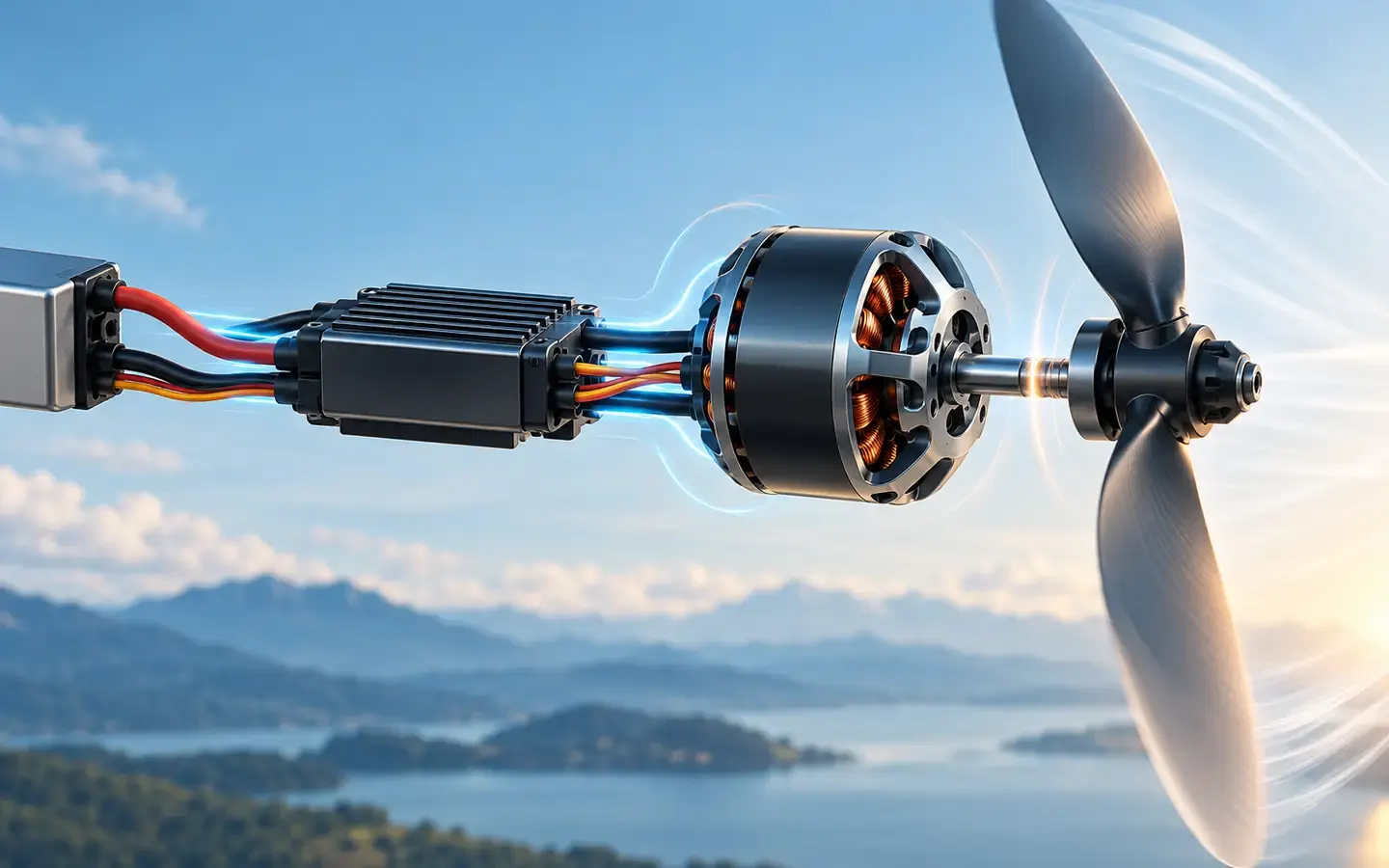 Basic
How Do a Brushless Motor, ESC and Propeller Work Together?
Trace how an ESC commutates a brushless motor and how a propeller turns rotation into thrust.
Robotics6 min read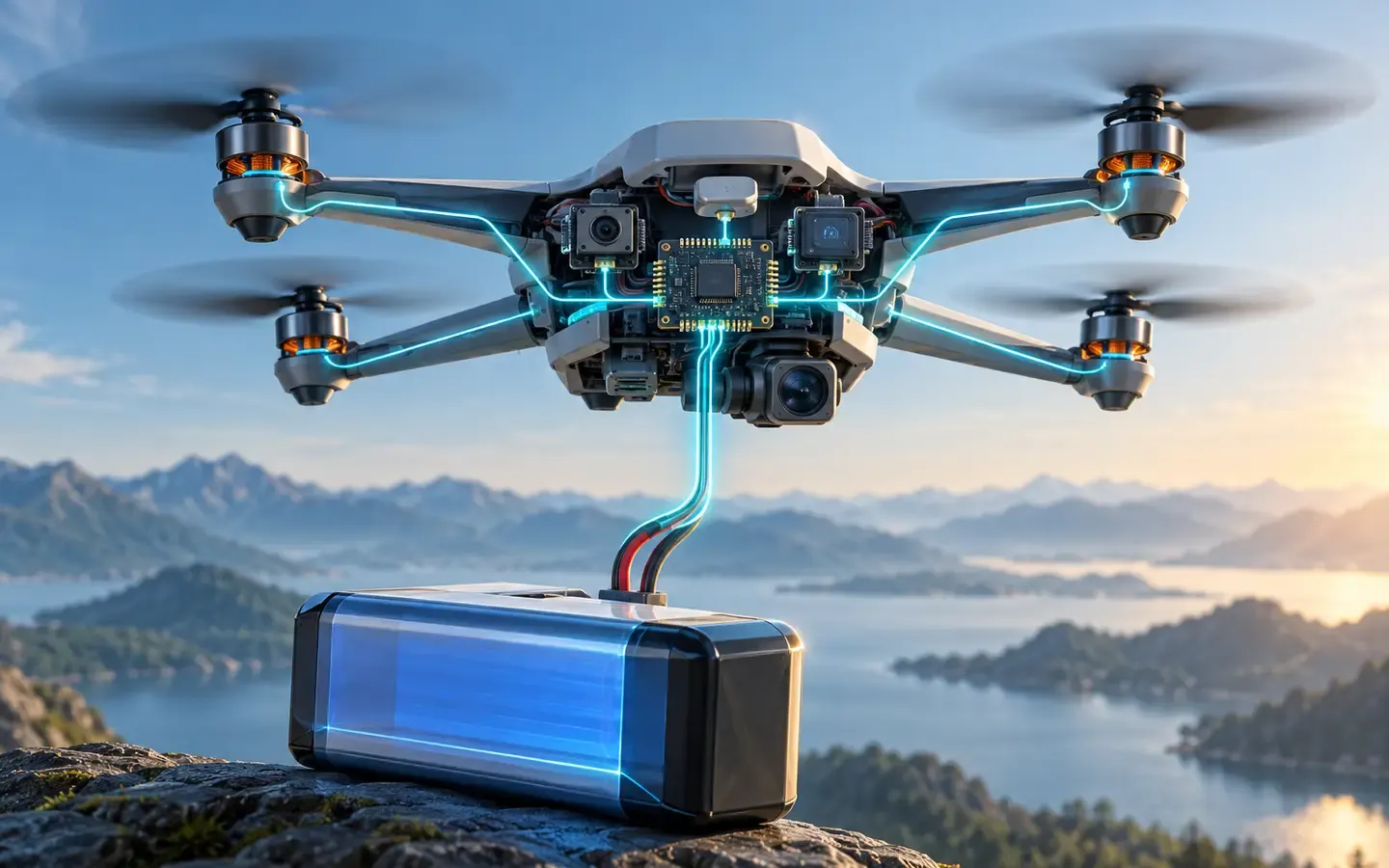 Basic
How Does a LiPo Pack Power a Drone and Set Its Flight Time?
Trace power from battery to motors, distinguish capacity from energy and estimate duration from load.
Robotics5 min read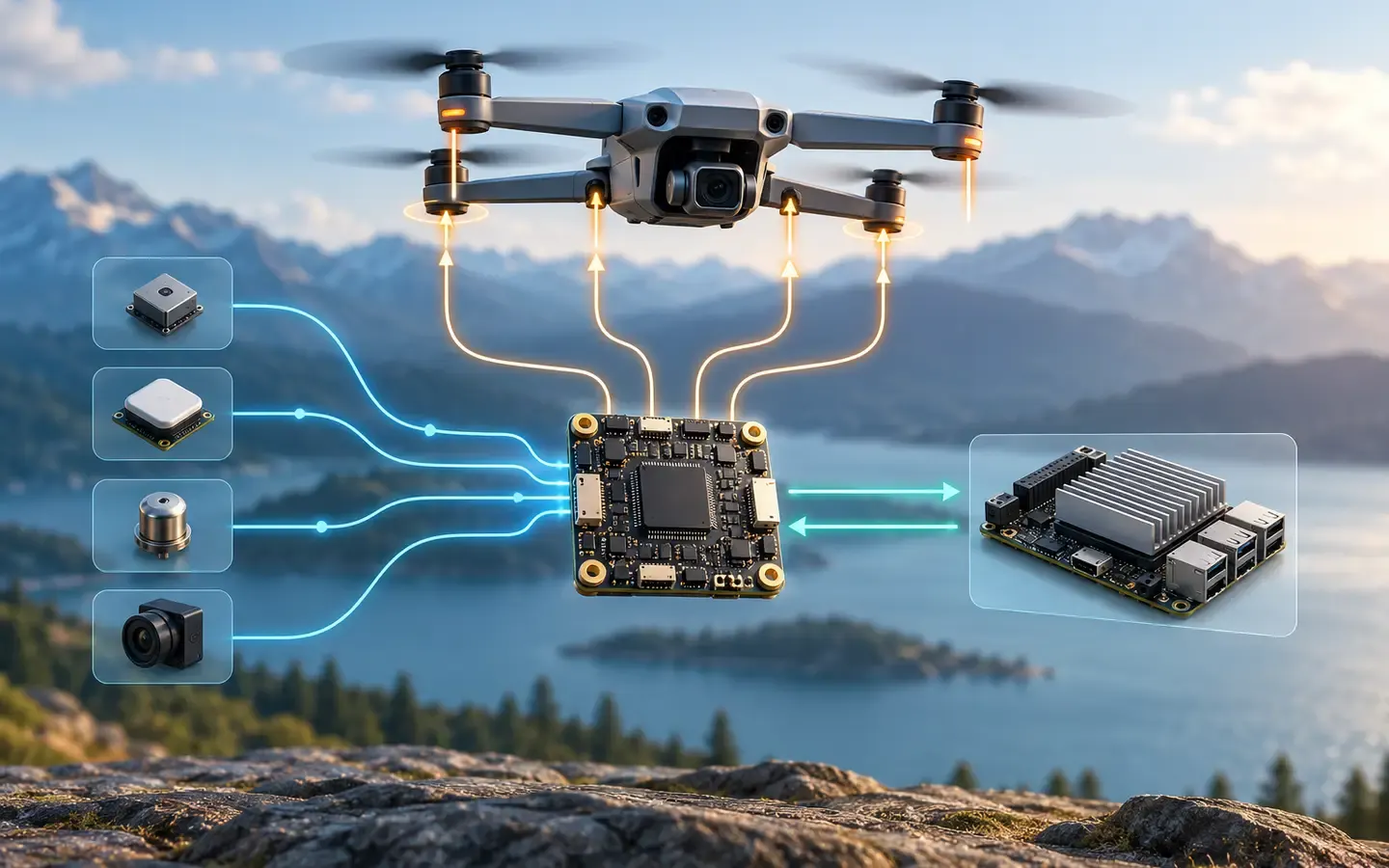 Basic
What Does a Flight Controller Do in Each Control Loop?
Trace a control loop from sensor samples and state estimates through error, actuator commands and feedback.
Robotics6 min read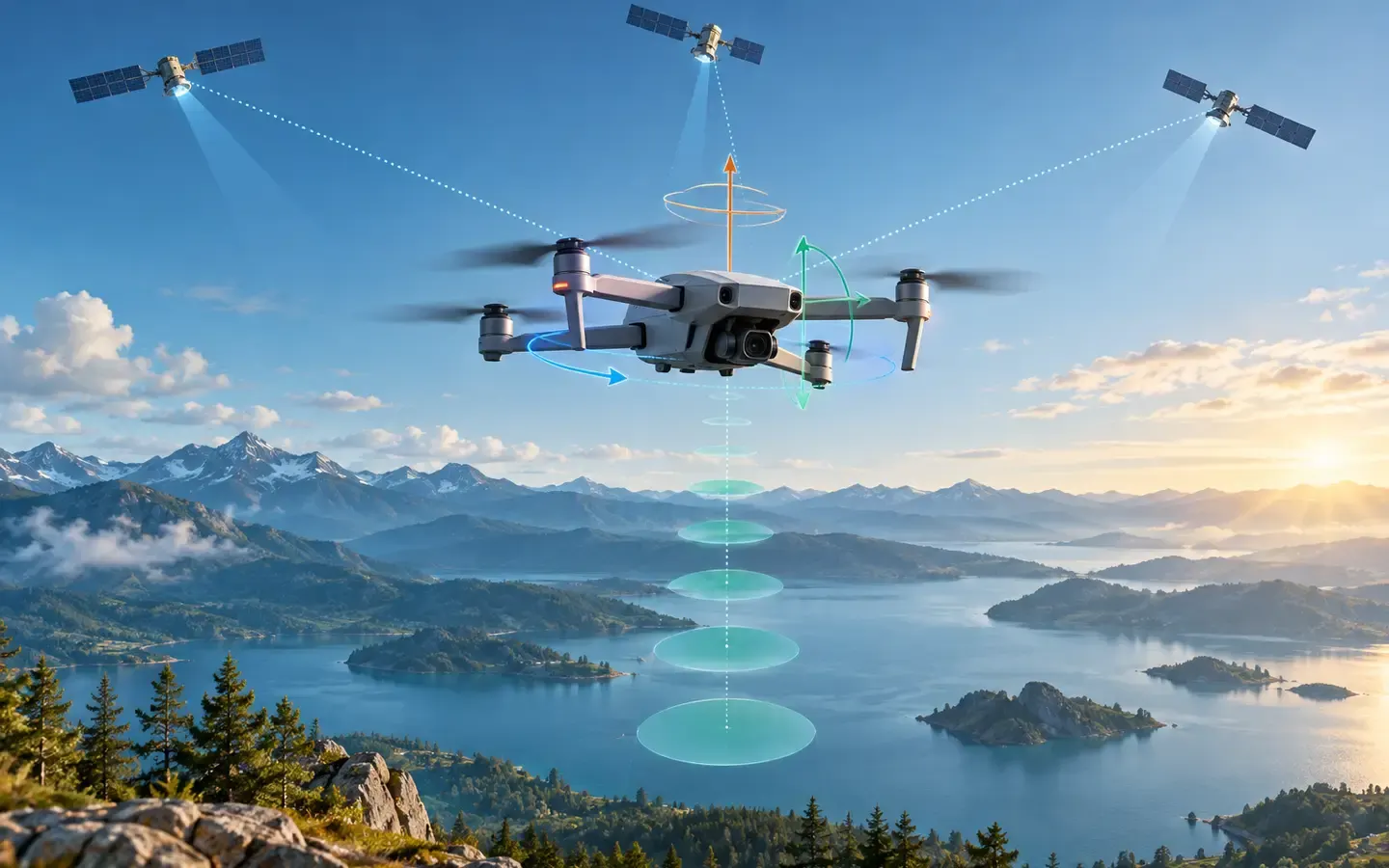 Basic
How Does a Drone Use Its IMU, Barometer and GPS?
Learn how an IMU, barometer, GPS, and estimator combine measurements to infer a drone’s state.
Robotics6 min read


Sources
These sources are written for older readers. If they feel hard, read them with an adult.
- PX4 System Architecture(opens in a new tab)
PX4Tier C: other sourcesRead on October 30, 2026
- Actuators(opens in a new tab)
PX4Tier C: other sourcesRead on October 30, 2026
- Power Systems(opens in a new tab)
PX4Tier C: other sourcesRead on October 30, 2026