

How Do Batteries Store Energy?
- Basic
- Article
- Ages 12+
- 5 min read

A battery stores energy as chemical potential. When it is connected to an external circuit, electrons move through the circuit while ions move through the electrolyte, and the chemical potential energy becomes electricity. In a rechargeable battery the movement can reverse, restoring chemical potential energy.
Contents
What you will learn
- Point out where a battery holds energy while it is not connected.
- Trace the paths of electrons and ions as the battery supplies power.
- Explain how charging differs from discharging, and why an older battery weakens.
Before you start
It helps to know that an electric current is the movement of charged particles. If you do not, the terms are still explained as they appear.
Where is energy stored while the battery is set aside?
A battery accepts, stores and releases electricity on demand. To be stored, electricity must first be converted into a chemical potential form. When the battery is not connected to a circuit, the energy stays in the battery’s materials as chemical energy.
A battery consists of two electrical terminals called the cathode and the anode. Between them is a chemical material called the electrolyte. The energy is held in these materials, so a charged battery can be disconnected from the circuit to keep its chemical potential energy for later use.
Keep “electricity” and “chemical potential energy” apart. Electricity is what flows in the circuit. Chemical potential energy is energy kept in the materials, waiting to be turned into electricity.
Where do electrons and ions move?
To accept or release energy, a battery is coupled to an external circuit. Electrons move through the external circuit. At the same time, ions move through the electrolyte inside the battery. Ions are atoms or molecules with an electric charge.
The two paths are different. Electrons travel outside the battery, through wires and the device. Ions travel inside it, between the terminals. One path cannot replace the other, and with either one missing the circuit is incomplete.
In a rechargeable battery, electrons and ions can move in either direction through the circuit and the electrolyte. The direction decides whether the battery is charging or discharging.
How do charging and discharging differ, and does the battery recover fully?
When electrons move from the cathode to the anode, they increase the chemical potential energy, which charges the battery. When they move the other way, they convert chemical potential energy into electricity in the circuit, which discharges the battery.
These processes do not completely reverse. After many charge and discharge cycles, the lack of complete reversal can change the chemistry and structure of the battery’s materials. Performance and safety can decline.
This is why an older battery is usually weaker than a new one. A full charge does not return the materials to exactly their original state.
Real-world example
Follow a small lamp connected to a battery. When the circuit closes, electrons flow from the battery through the wire to the lamp and back. Inside the battery, ions move through the electrolyte. The chemical potential energy falls as the battery discharges, and the lamp receives electricity.
Break the circuit and the electrons stop. The remaining energy stays in the battery’s materials as chemical energy, ready for next time. With a rechargeable battery, connecting it to a charging source makes electrons and ions move the opposite way, and the chemical potential energy rises.
Common misunderstandings
A battery does not hold electricity like a tank holds water. It holds chemical potential energy, and electricity appears only when an external circuit is connected.
Electrons do not travel through the electrolyte. Ions move through the electrolyte, while electrons move through the external circuit.
Charging does not return everything to like-new. Chemical and structural changes accumulate over time.
Frequently asked questions
What is an ion?
An ion is an atom or molecule with an electric charge. In a battery, ions move through the electrolyte.
Must a charged battery stay connected?
No. A charged battery can be disconnected from the circuit to keep its chemical potential energy for later.
Why can an older battery perform worse?
Charging and discharging do not completely reverse. Over time they can change the chemistry and structure of the materials, lowering performance.
Summary
- A battery stores energy as chemical potential in its materials.
- Electrons move through the external circuit and ions through the electrolyte.
- Charging and discharging are two directions of movement; the incomplete reversal makes batteries wear over time.
Terms in this article
English and Vietnamese terms, with the meanings used here. Hover, tap or Tab to a term with a dotted underline for an explanation as you read.
- chemical potential energythế năng hóa học
- Chemical energy stored in a battery for later use.
- ionsion
- Electrically charged atoms or molecules.
- electrolytechất điện phân
- The internal battery material through which ions move.
- cathodecatốt
- One of the battery's two electrical terminals; in the source, electrons move from cathode to anode while charging.
- anodeanốt
- The battery's other electrical terminal, across the electrolyte from the cathode.
- external circuitmạch ngoài
- The circuit coupled to the battery, through which electrons move as it accepts or releases energy.
This article is not marked as viewed
Spotted something wrong or unsafe?
Tell the administrator by email. The message already has the article title and address.
More in this topic
 Basic
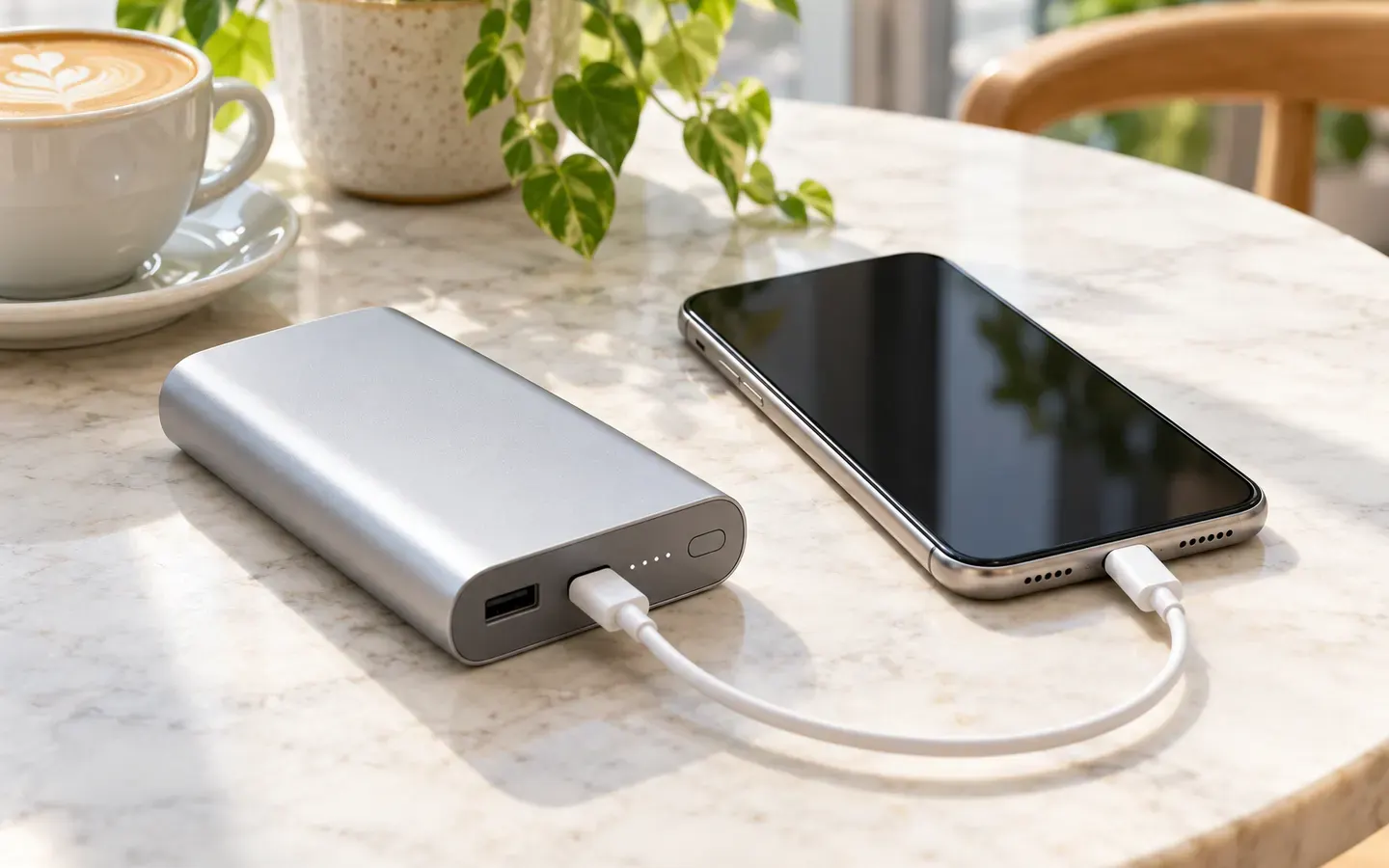
How Do Power Banks Store and Deliver Energy?
Trace energy while charging and using a power bank; distinguish chemical storage, charging control and output voltage conversion in an illustrative design.
3 min read Starter
What Is Green Energy?
Distinguish renewable energy from green power through solar and wind examples, while recognising environmental impacts that still matter.
5 min read Starter
How Do Solar and Wind Power Generate Electricity?
Trace sunlight through photovoltaic cells and wind through a rotor and generator, comparing how each technology produces electricity.
5 min read Intermediate
How Does Battery Capacity Affect Runtime?
Relate battery energy, power demand and runtime; compare devices under matching conditions rather than judging only capacity or remaining percentage.
3 min read


Sources
These sources are written for older readers. If they feel hard, read them with an adult.
- DOE Explains...Batteries(opens in a new tab)
US Department of EnergyTier A: government, standards or research bodiesRead on October 31, 2026