

Which Wireless Links Do Drones Use for Commands and Data?
- Starter
- Article
- Ages 10+
- 7 min read

A drone's wireless links are the radio paths connecting a ground control station, the vehicle and sometimes a monitoring station. A design may use one path for control, another for telemetry and Wi-Fi or cellular service for additional data; the choice depends on coverage, bandwidth, latency and available fallback paths.
Contents
- Controller, left
- Drone, right
- Outbound command, upper arrow
What you will learn
- Trace command and telemetry paths between system components.
- Compare telemetry radios, Wi-Fi and cellular service using shared criteria.
- Recognize why a drone design may need to consider more than one link.
Before you start
No flight experience is needed. Telemetry means status data, such as position, sent back for an operator or software to observe.
A link has several endpoints
A command travels from ground software to a receiver or onboard computer and then to the flight controller; status travels back along the corresponding path. In a documented PX4 setup, a telemetry radio can provide a wireless MAVLink connection between a ground station and the vehicle. If a companion computer is present, it can also route data toward a ground station or another network. These are logical roles; one product may combine several roles in one device.
MAVLink specifies message encoding, not a radio wave. The endpoints need a compatible protocol, while the transport layer determines whether messages travel over a serial cable, telemetry radio, Wi-Fi or a route through cellular service. So “MAVLink works” does not tell you whether the link has enough coverage or capacity for a task.
How should you compare link types?
No single option wins on every criterion. PX4 documentation describes dedicated telemetry radios and Wi-Fi telemetry; Wi-Fi typically has shorter range but higher data rates, making it more suitable when video also needs transport. The guide also describes an LTE module attached to a companion computer to route MAVLink over the internet, rather than plugging that module directly into the flight controller.
| Option | Coverage and infrastructure | Relative bandwidth | When to consider it |
|---|---|---|---|
| Telemetry radio | A dedicated radio path between vehicle and station | Intended for telemetry; not automatically a video path | When exchanging status and lightweight commands |
| Wi-Fi | Usually local coverage; needs a compatible network | Higher than telemetry radio in the PX4 guide | When combining telemetry with a video stream |
| Cellular service | Depends on service coverage and an internet route | Can carry MAVLink through a companion computer | When the architecture needs a wide-area relay |
This is a qualitative comparison, not a promise about distance or throughput. Latency also depends on network load, configuration and routing; one modem's figures cannot represent every location. Useful coverage can differ from advertised coverage because obstacles, interference and antenna placement change the real link.
Why do commands and telemetry need different delivery patterns?
Telemetry is often a stream of changing values. If an old position sample arrives late after a newer one is available, an application may care more about the newer sample. By contrast, when changing configuration or synchronizing a mission list, the sender needs to know whether the operation was received; the MAVLink protocol describes point-to-point exchanges with retransmission for transactions that need guaranteed delivery.
That does not mean every control message has been confirmed just because a link is active. An application should distinguish “packet arrived,” “command accepted” and “request completed.” Each state answers a different question. If a reply is missing, software should report an unknown outcome instead of assuming success.
A worked scenario
Imagine a simulator where a laptop displays position over a telemetry radio while an onboard companion computer sends images over Wi-Fi. Trace the two flows: the application creates a request, a message crosses its selected connection to the controller, telemetry returns to update the interface, and video reaches the viewer. If the picture freezes while position keeps updating, the fault may be in the video path; if both stop, inspect components shared by the paths or the data source. This is fault-isolation reasoning for a model, not a test result from a drone.
A fallback design should state which information remains available if one path fails. Two radios that share a power supply, sit next to each other or depend on the same computer do not provide independent redundancy.
Common misunderstandings
MAVLink is not the name of a radio. It defines messages and communication rules; a radio is one transport choice.
Signal bars do not prove a command ran. Signal strength does not replace a reply or the controller's reported state.
Frequently asked questions
Do drones use Wi-Fi to receive commands?
A setup can use Wi-Fi telemetry, but a particular drone's link depends on its hardware and implementation.
Does cellular service connect directly to the flight controller?
The PX4 guide describes an LTE module connected to a companion computer to route MAVLink; it does not describe plugging that module directly into the flight controller.
How do I choose a link?
First identify the data, coverage, bandwidth, latency, available infrastructure and loss-detection needs; then confirm that the actual equipment meets those requirements.
Summary
- Commands and status pass between ground software, vehicle and controller through defined endpoints.
- Telemetry radios, Wi-Fi and cellular service trade off coverage, data capacity and infrastructure differently.
- A message protocol cannot guarantee that a wireless link has suitable quality.
Terms in this article
English and Vietnamese terms, with the meanings used here. Hover, tap or Tab to a term with a dotted underline for an explanation as you read.
- wireless linkliên kết không dây
- A radio path connecting endpoints that send commands or status in a drone system.
- telemetry
- Measurement and status information transmitted so a system can be observed.
- MAVLink
- A binary telemetry protocol for resource- and bandwidth-constrained systems.
- ground control stationtrạm điều khiển mặt đất
- Software or equipment on the ground used to communicate with a vehicle.
This article is not marked as viewed
Spotted something wrong or unsafe?
Tell the administrator by email. The message already has the article title and address.
You may also like
 Starter
What Can a Drone Do with Computer Vision?
Compare detection, tracking, segmentation and motion estimation in a drone vision system, including their outputs and the companion computer.
Artificial intelligence5 min read Basic
How Do PX4 and ArduPilot Differ?
Compare PX4 and ArduPilot by architecture, hardware, simulation tools and project requirements.
Internet of Things (IoT)6 min read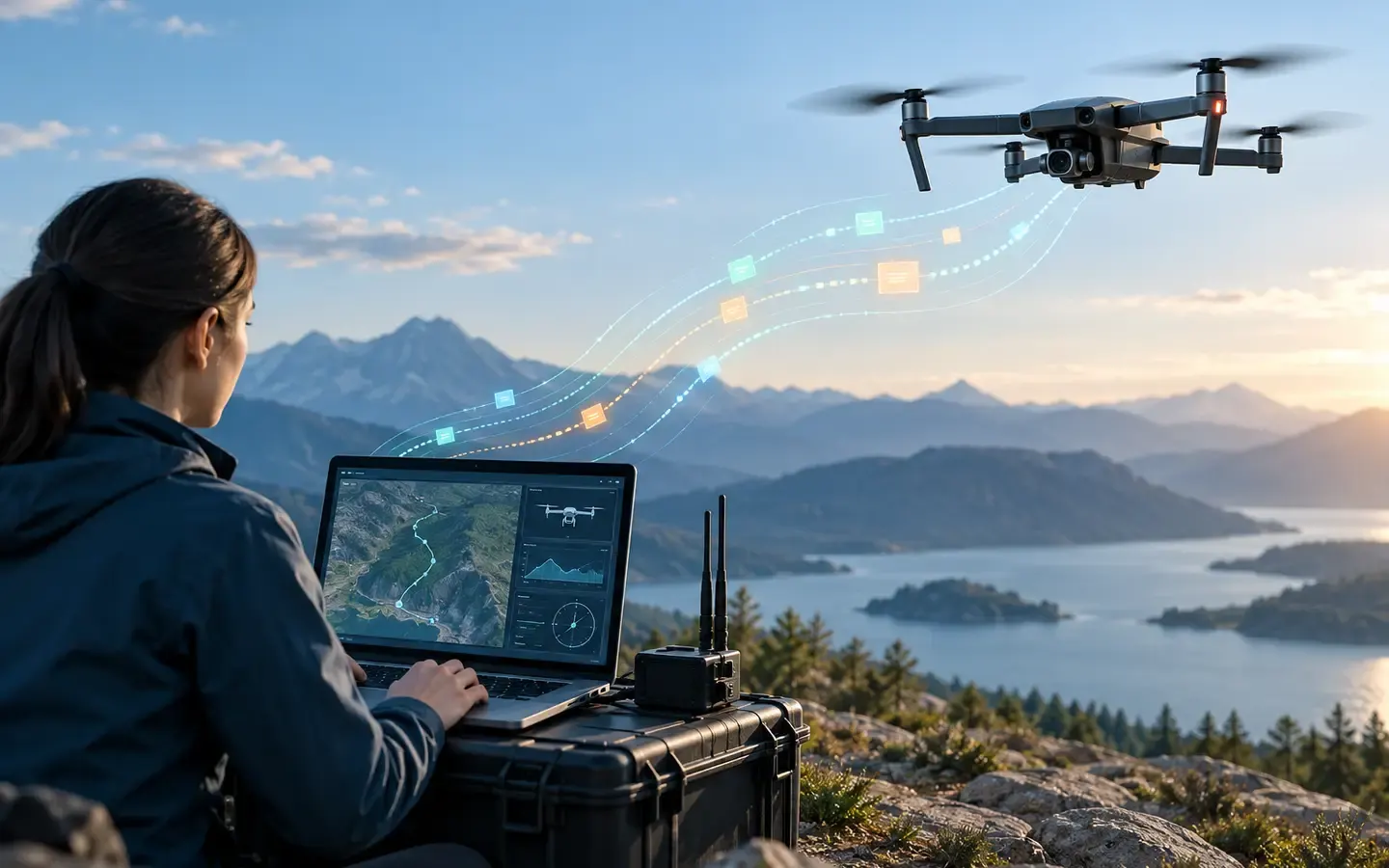 Basic
How Does MAVLink Carry a Command to a Flight Controller?
Follow how MAVLink sends commands, receives ACKs and separates protocol acknowledgement from task completion.
Internet of Things (IoT)6 min read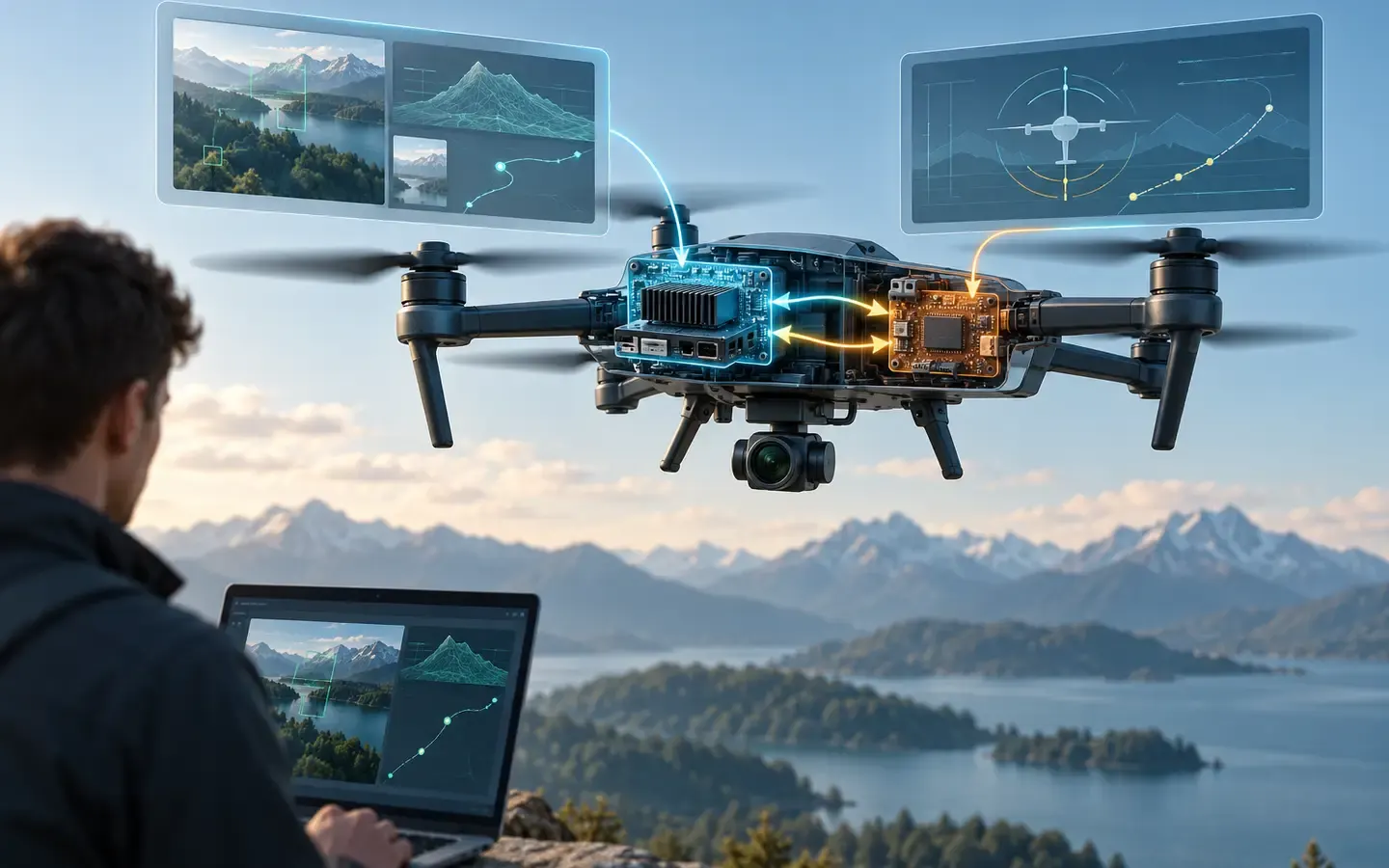 Intermediate
How Does a Companion Computer Link to a Flight Controller?
Trace serial or Ethernet connections, bidirectional protocols and signals that reveal command results or link loss.
Internet of Things (IoT)6 min read


Sources
These sources are written for older readers. If they feel hard, read them with an adult.
- MAVLink Protocol Overview(opens in a new tab)
MAVLinkTier C: other sourcesRead on October 30, 2026
- Telemetry Radios/Modems(opens in a new tab)
PX4Tier C: other sourcesRead on October 30, 2026
- Companion Computers(opens in a new tab)
PX4Tier C: other sourcesRead on October 30, 2026