

How Does Material Selection Go from Needs to Options?
- Basic
- Article
- Ages 15+
- 5 min read

Choosing a material runs from the part's requirements to a list of suitable materials. First state the function the part must serve, then separate fixed variables from free ones, write the goal as a performance index containing only material properties, and finally rank materials and check other conditions.
Contents
- Functional requirement
- Geometry
- Material properties
What you will learn
- Name the three factors that decide a part's performance.
- Tell variables fixed by the application from free variables.
- Describe how a requirement becomes a performance index and a shortlist.
Before you start
Reading the article on Ashby charts first helps with performance indices, but it is not required.
Where does material selection start?
It starts from the part's requirements, not from a familiar material. The Northwestern University Materials Design text says a component's performance is governed by three factors: the functional requirement, such as carrying load, transferring heat or withstanding shock, then the geometry, and the material properties.
Choosing a material while ignoring the other two factors is therefore not enough. The same material can suit one part and not another.
Which variables are fixed and which are free?
The application sets some values, and the rest are free variables. The University of Cambridge Young's Modulus - Density selection map package considers an aircraft panel in bending: the application sets the panel length, width and load, while the thickness is not set.
Thickness is a free variable. A thin panel of a dense material or a thick panel of a light material may both be valid. This free variable decides which material wins.
- Panel with fixed size and load
- Thin panel
- Fixed span
How do requirements become an index and a shortlist?
Combine the equations so the free variable cancels and only material properties remain. For that panel, to get the minimum deflection at a given mass, or the minimum mass at a given deflection, a combination of properties must be maximised. The package calls that combination a merit index.
Values set by the application do not change with the material, so they are left out of the index, which keeps only material properties. Then the index values are compared across materials, often on a selection chart.
That is not the end. In the software example of the Northwestern text, cold worked tool steels passed stage one but failed stage two, while wrought austenitic stainless steels did the opposite. So the shortlist must still pass other conditions.
- Many starting materials
- The remaining shortlist
- The chosen material
Real-world example
Follow the bending-panel example in the Cambridge package:
| Step | Decision in this example |
|---|---|
| Requirement | Carry the load within the allowed deflection, while keeping mass low |
| Fixed | Length, width and load are set by the application |
| Free | Material and panel thickness |
| Ranking | Maximise the cube root of Young's modulus divided by density, the index for this problem |
| Further checks | Retain candidates that also meet the application's remaining conditions |
A high Young's modulus alone does not decide the choice: density is also in the index, and thickness must be adjusted for each option. The multistage Northwestern example shows why passing one stage is insufficient. The output is a shortlist meeting the requirements, rather than a material that wins for every part.
Common misunderstandings
Selecting a material means picking the strongest. Performance also depends on the functional requirement and the geometry, not only on material properties.
Every value enters the index. Values set by the application are left out of the index.
Passing one stage is enough. In the text's example, a material can pass one stage and fail another.
Frequently asked questions
What three factors decide a part's performance?
The functional requirement, the geometry and the material properties.
What is a free variable?
A quantity the application does not fix, such as the panel thickness in the example, which can be traded against the material.
Why does the index contain only material properties?
Because values set by the application do not change with the material, they are left out of the index.
Summary
- A part's performance depends on the functional requirement, the geometry and the material properties.
- The application fixes some variables; the free variable is eliminated so the index holds only material properties.
- The ranked list must still pass other conditions before a choice is made.
Terms in this article
English and Vietnamese terms, with the meanings used here. Hover, tap or Tab to a term with a dotted underline for an explanation as you read.
- functional requirementyêu cầu chức năng
- What the part must do, such as carry load, transfer heat or withstand shock.
- free variablebiến tự do
- A quantity the application does not fix, such as panel thickness, that can be traded against material.
- performance indexchỉ số hiệu năng
- A combination of material properties that must be maximised to reach a design goal.
This article is not marked as viewed
Spotted something wrong or unsafe?
Tell the administrator by email. The message already has the article title and address.
More in this topic
 Basic
How Do Strength, Hardness and Ductility Differ?
Tell strength, hardness and ductility apart through yield strength, tensile strength and elastic and plastic deformation to read mechanical properties.
5 min read Basic
What Do Tensile and Hardness Tests Measure?
See how a tensile test records force and extension, why results become stress and strain, and what a hardness test derives from the dent of an indenter.
5 min read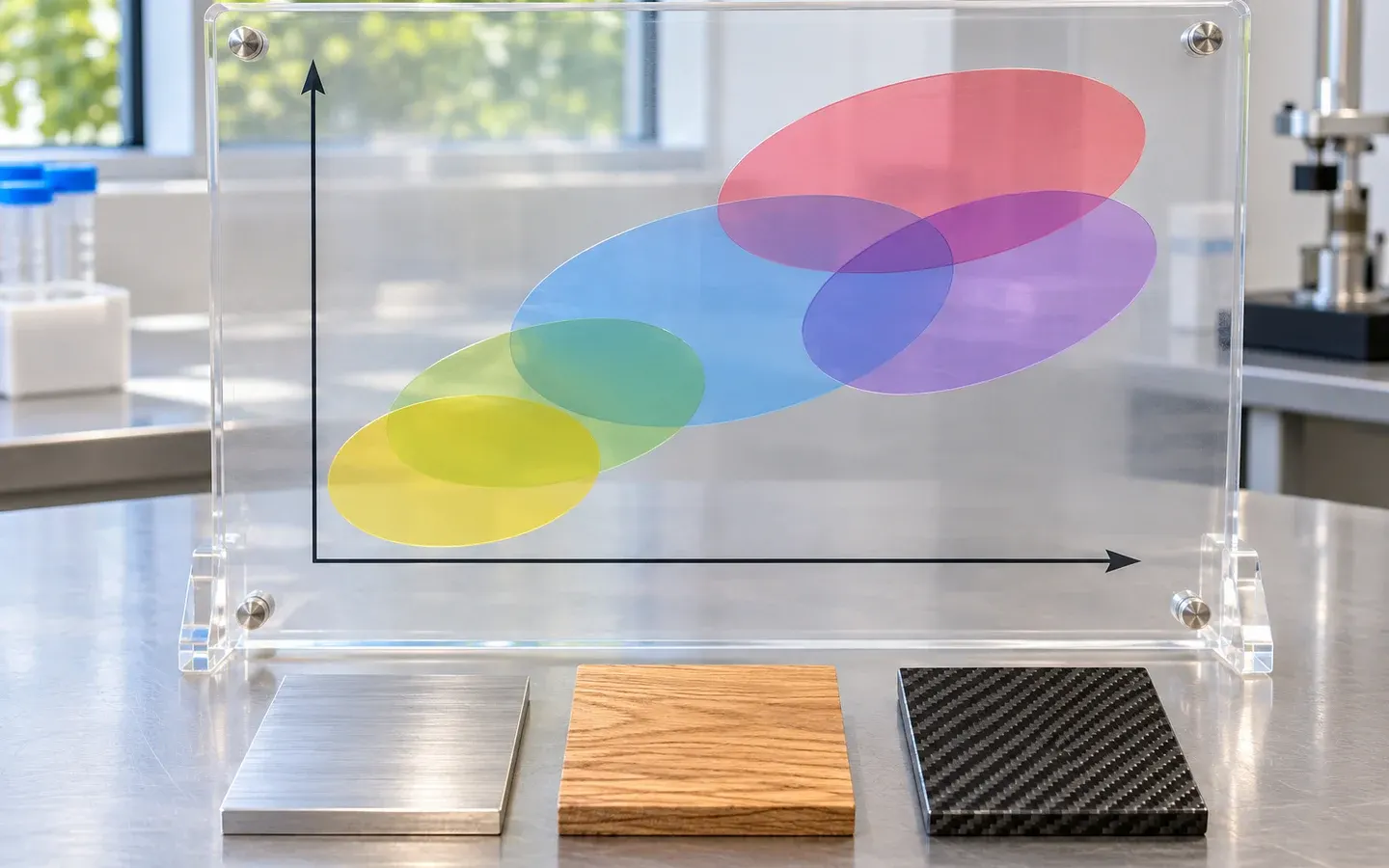 Basic
How Do Ashby Charts Help Compare Materials?
Understand how an Ashby chart puts many materials on two properties, why it uses log scales and how sliding an index line picks a material.
5 min read Starter
Which Families Do Engineering Materials Belong To?
Meet the four engineering material families, metals, polymers, ceramics and composites, their typical properties and how to spot them in everyday objects.
5 min read


Sources
These sources are written for older readers. If they feel hard, read them with an adult.
- Young's Modulus - Density selection map(opens in a new tab)
University of Cambridge, DoITPoMSTier A: government, standards or research bodiesRead on November 3, 2026
- 390: Materials Design(opens in a new tab)
Northwestern University, MSE CoreTier A: government, standards or research bodiesRead on November 3, 2026