

What Is the Internet of Things?
- Starter
- Article
- Ages 10+
- 4 min read

The Internet of Things (IoT) is a global infrastructure for the information society. It enables advanced services by interconnecting things, both physical and virtual, using existing and evolving interoperable information and communication technologies. This is the definition given in an ITU-T Recommendation.
Contents
- An example of a smart object
- A link
- A screen for viewing data
What you will learn
- Say what IoT is in your own words.
- Explain why people connect things to a network.
- Spot where the term IoT came from and why small devices have limits.
Before you start
No prior knowledge needed. Knowing how to use a phone or a computer is enough.
What is a "thing" in IoT?
IoT includes physical and virtual things interconnected through interoperable information and communication technologies. An IETF document describes smart objects as computing devices that can understand and react to their surroundings; this describes smart objects, not a requirement that every IoT thing be a sensor, actuator or computer.
RFC 8576 also calls the computing devices it describes smart objects or smart devices.
For example, building-automation devices, cellular phones and machine-to-machine (M2M) devices all benefit from interacting with other things nearby or somewhere on the Internet.
- The surroundings
- An example of a smart object
- Exchange in both directions
- Another thing
Why do people connect things to a network?
People connect things to a network to process, view and gain insight from the data the things collect. A growing number of products put the Internet Protocol Suite on smaller and smaller devices to do this.
When data from many different devices is combined, the network effect can increase.
- Many different devices
- Where data is gathered
- Results to view
Where did the term IoT come from?
The term IoT was first coined in 1999 by the Auto-ID center. The center envisioned a world where every physical object has a radio-frequency identification (RFID) tag with a globally unique identifier.
Since then, the meaning of IoT has expanded. It now encompasses a wide variety of technologies, objects and protocols.
- A radio identification tag
- A thing
- A different kind of thing
What limits do small IoT devices have?
Small devices often run with few resources. Some constrained devices may work under severe limits, such as limited battery and computing power and little memory.
So when you think of IoT, do not picture every thing as powerful as a phone.
- A nearly empty battery
- Small memory
- A larger server
Real-world example
Try this with an adult. Look around your home and choose three items that can connect to a network or to other items, such as a phone. For each one, ask whether it sends or receives information. If it does, where does it get that information, and does it react to it?
Common misunderstandings
IoT is only smart home gadgets. According to an IETF document, the meaning of IoT has expanded and now encompasses a wide variety of technologies, objects and protocols.
Every IoT device is as powerful as a phone. Another IETF document says constrained devices may have limited battery and computing power and little memory.
IoT is a very new term. According to an IETF document, the term was first coined in 1999.
Frequently asked questions
What does IoT stand for?
IoT stands for Internet of Things. An ITU-T Recommendation defines it as a global infrastructure for the information society.
Who coined the term IoT?
The Auto-ID center first coined the term in 1999. The center envisioned every physical object carrying a radio-frequency identification tag.
What does RFC 8576 call smart objects?
RFC 8576 also calls the computing devices it describes smart objects or smart devices.
What is the data from IoT devices used for?
The collected data can be processed, visualized and used to gain insight.
Summary
- IoT interconnects physical and virtual things through interoperable information and communication technologies; some smart objects are computing devices that sense or react to their surroundings.
- People connect things to process and view data, and combining data from many devices can increase the network effect.
- The term IoT was coined in 1999 and now covers much more, while small devices may have limited battery, computing power and memory.
Terms in this article
English and Vietnamese terms, with the meanings used here. Hover, tap or Tab to a term with a dotted underline for an explanation as you read.
- Internet of ThingsInternet vạn vật
- Infrastructure that interconnects physical and virtual things through interoperable information and communication technologies to enable advanced services.
- Smart objectVật thông minh
- A computing device that can receive information from its surroundings and respond.
- Constrained deviceThiết bị bị ràng buộc
- A device with tight limits on battery power, processing or memory.
- RFID tagThẻ nhận dạng bằng sóng vô tuyến
- A tag identifying an object by radio; the early IoT vision gave each object its own identifier.
- Network effectHiệu ứng mạng
- An effect of a network that can increase when data from many devices is combined.
This article is not marked as viewed
Spotted something wrong or unsafe?
Tell the administrator by email. The message already has the article title and address.
More in this topic
 Starter
How Do IoT Devices Connect to One Another?
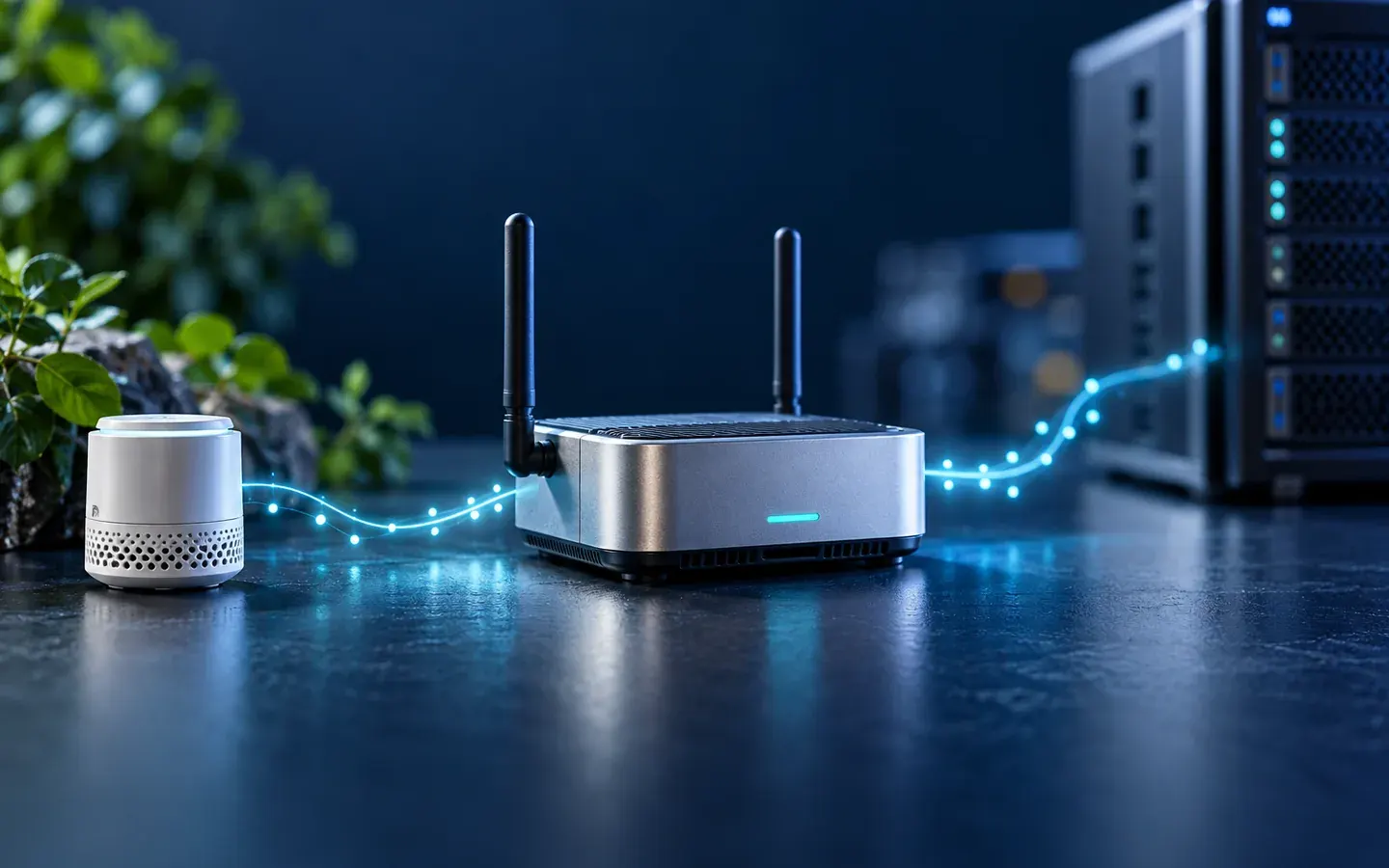
How IoT devices talk to each other directly, send data to the cloud or go through a gateway. A beginner's guide to the ways devices connect.
4 min read Starter
Where Do We Encounter IoT Sensors?
Where IoT sensors turn up around us: in the home, on farms, in healthcare and in cities. A first article for complete beginners.
4 min read Starter
Explore an IoT Actuator Through an Example
Explore control signals, energy sources and motion mechanisms through an example of an IoT actuator.
4 min read Starter
Why Does the IoT Microcontroller Matter?
What a microcontroller is, where it sits in an IoT device and why its small memory and limited power make it matter. A first article for beginners.
3 min read


Sources
These sources are written for older readers. If they feel hard, read them with an adult.
- Internet of Things Global Standards Initiative(opens in a new tab)
ITU-TTier A: government, standards or research bodiesRead on October 28, 2026
- RFC 8576: Internet of Things (IoT) Security: State of the Art and Challenges(opens in a new tab)
IETF (RFC Editor)Tier A: government, standards or research bodiesRead on October 28, 2026
- RFC 7228: Terminology for Constrained-Node Networks(opens in a new tab)
IETF (RFC Editor)Tier A: government, standards or research bodiesRead on October 28, 2026
- RFC 7452: Architectural Considerations in Smart Object Networking(opens in a new tab)
IETF (RFC Editor)Tier A: government, standards or research bodiesRead on October 28, 2026