

How Does a Robot Mop Clean and Leave the Floor Dry?
- Intermediate
- Article
- Ages 16+
- 7 min read

A mopping robot cleans with a microfibre pad that is only damp. A metering pump delivers water in step with the robot's speed so each spot gets a similar amount, and it stops when the robot halts or is lifted. The remaining thin film evaporates gradually; finishing a pass does not mean the floor is immediately dry, since material, water quantity and ambient conditions still matter. A scent spray is an optional module, off by default.
Contents
- Robot body
- Damp pad with many small pores
- Thin water film fading out
- Dry floor
- Floor not yet mopped
- Vapour rising
- Direction of travel
What you will learn
- Explain why a damp pad leaves a dry floor while a soaked pad does not.
- Follow how a metering pump tracks robot speed, and what must happen when the robot jams, collides or is lifted.
- State why a scent module must be off by default and switched on only per area.
Before you start
You only need to know what parts a mopping robot has, for example from the articles What Does a Mini Mopping-Robot Fleet Include? and How Is a Mop Robot Built to Fit Under a Bed?. The designs below are illustrative models, not results from a real robot.
How does a damp pad clean a floor that still dries?
A damp pad holds water in the tiny pores of its fibres and releases only a thin film onto the floor, so that film dries quickly. A study of evaporation on porous fabric links evaporation from porous fabric to water drawn into the pores by capillary action. The same study reports that spreading and wicking carry water through the substrate, which enlarges the wetted surface area and promotes evaporation.
For a robot this suggests a design rule: keep the pad damp and never let it become a continuous water supply. A person sweeps first, because a damp pad is meant for a thin layer of dirt, while loose objects are cleared by hand.
A mopping assembly in a patent on a mopping assembly follows the same idea: it dispenses more fluid when the cloth is dry and less when it is damp. The same document notes that the flow rate may change during a session, based on elapsed time or on a sensor showing the cloth is damp.
How does a metering pump keep the water even as speed changes?
For each square metre to receive a similar amount of water, the pump flow must follow the robot's speed. With a fixed flow, a slow stretch receives more water than a fast one. A patent on wet-cleaning robots observes that conventional machines typically output a constant flow rate, so excess fluid tends to pool when they reverse slowly. It also says the flow rate can be varied in proportion to the distance from a wall or to the target speed of the drive system.
The table lists situations and what the pump must do. The last two rows follow that patent; the first two are illustrative design.
| Situation | What the pump does |
|---|---|
| Robot moving steadily | Pumps at a flow matched to speed |
| Robot slowing or turning | Reduces flow with speed |
| Collision | Reduces flow or stops pumping |
| Lifted off the floor | Controller stops the pump motor |
For the collision row, the patent says the pump is automatically controlled to reduce the flow rate or stop pumping in response to the collision event. For the lifted row, a lift-up sensor detects when the cleaner is lifted off the surface, and that information goes to the controller, which can halt the pump motor.
Pad pressure also matters. More pressure may increase contact but does not guarantee better cleaning; drag can rise, so the wheel motors work against more load and the battery drains faster. This is design reasoning; the pressure needs to be chosen by measuring on a real robot.
This links to the article on close-range sensors. A sudden rise in motor current is a sign of a jam, and the reflex layer must stop the pump before it plans a new route.
- Robot in each of the three rows
- Speed arrows (long means fast)
- Evenly spaced drops
- Puddle when the pump keeps a fixed flow
- Travel lines
How does the robot spot carpet, and how is the pad cleaned at the dock?
A robot must not mop carpet, and a dirty pad must be washed and dried before the next run. An Ecovacs guide says that in mopping mode the pad plates lift automatically only when carpet is detected. The same guide records a limit: a mat that is too thin may not be detected by the sensor. The illustrative design therefore adds a map in which a person marks carpet zones, so the robot does not depend on a single sensor.
Washing the pad belongs to the dock. According to iRobot's guide, after cleaning the dock washes and then dries the pad, and it dries it by blowing air. The same guide says that when a mission starts from the app, the robot warns the user if there is a reason it cannot mop. The illustrative design borrows both ideas: a clean, dry pad before the next run, and a stated reason whenever the robot refuses to mop.
- Robots
- Pad touching the floor
- Carpet strip
- Pad lifted over the carpet
- Dock
- Pad washing roller
- Drying airflow
- Hard floor
When should the scent module run, and why is it off by default?
The scent module is an add-on, so it is off by default and switched on only for areas the user chooses. The reason lies in indoor air. EPA lists air fresheners among the household products that are sources of volatile organic compounds (VOCs), and says elevated concentrations can persist in the air long after the activity is completed.
An article in Environmental Health Perspectives adds two points. A survey of scented products found that even products advertised as green, natural or organic emitted as many hazardous chemicals as standard ones. Some ingredients, such as limonene, react with ozone in ambient air to form dangerous secondary pollutants, including formaldehyde. The article also quotes a researcher who hears from people describing respiratory, dermatological and neurological problems they attribute to scented products. That is a report, not a conclusion about risk.
From this the illustrative design sets three rules for the module:
- Off by default, switched on per area chosen by the user, and skipped where sensitive people or pets are.
- Do not prescribe one spray dose for every product. In this model, the module stays off until a suitable product and conditions of use have been established.
- A visible off switch in the app at all times.
EPA advises increasing ventilation when using products that emit VOCs. According to EPA's page on improving indoor air quality, usually the most effective way is to eliminate individual sources of pollution or reduce their emissions. This article gives no advice on choosing or mixing scent liquids; that is out of scope.
- Zone the user has enabled
- Metered spray and the robot
- Zone with a sensitive person: off
- Zone with a pet: off
- Open window for ventilation
- Off switch in the app
Real-world example
A small office has a stone floor and one rug in the reception area. This is a design scenario, not a test result. After the quick sweep by a person, the robot runs down the corridor with the pump tracking speed, so the floor dries soon after the pad.
At the corridor corner the robot turns and slows, and the pump reduces with it. At the rug edge the carpet sensor fires, the pad plate lifts and the robot marks the area as no-mop. Then it jams under a chair leg: motor current rises, the reflex layer stops the pump first, and the robot backs out. If the pump kept running while the robot stood still, a puddle would form on the spot. That is the design fault the table above is meant to prevent.
Back at the dock the pad is washed and dried. The scent module stays off, because the user has not enabled it for any area.
Common misunderstandings
More water means a cleaner floor. A soaked pad keeps the floor wet for longer and lets puddles form. A damp pad is usually enough, and the pump must follow speed so the amount stays even.
A mopping robot always knows what carpet is. A carpet sensor has limits: a mat that is too thin may go undetected. A person-marked zone is needed as well.
A scent spray makes the air cleaner. EPA places air fresheners among the products that emit VOCs, so a spray should not be treated as a way to clean the air. That is why the module is off by default.
Frequently asked questions
Does a mopping robot need a person to sweep first?
In this model, yes. A damp pad handles a thin layer of dirt, while loose objects and cluttered areas are cleared by a person.
Can a damp-mopping robot clean carpet?
It should not. The design uses a carpet sensor to lift the pad, plus person-marked carpet zones because a sensor can miss thin mats.
Should a mopping robot carry a scent module?
Only as an option, off by default and enabled per area. Consider sensitive people, pets and ventilation.
Summary
- A damp pad limits the water left behind; capillary action distributes water within the cloth, while drying time on the floor needs its own measurement.
- The metering pump follows robot speed, and must reduce or stop when the robot collides, jams or is lifted.
- The robot lifts the pad over carpet and washes and dries it at the dock; the scent module is off by default and enabled per area.
Terms in this article
English and Vietnamese terms, with the meanings used here. Hover, tap or Tab to a term with a dotted underline for an explanation as you read.
- damp padkhăn ẩm
- A microfibre pad that is only damp, holding water in the tiny pores of its fibres and releasing a thin film onto the floor.
- capillary actionmao dẫn
- The effect that draws water into the tiny pores of a porous material, such as the gaps between fabric fibres.
- wickingthấm hút
- Movement of water through a porous material by capillary action, which spreads the water over the surface.
- metering pumpbơm định lượng
- A pump that delivers a controlled amount of water, here adjusted to the robot's speed.
- lift-up sensorcảm biến nhấc máy
- A sensor that detects when the robot is lifted off the surface being cleaned.
- volatile organic compoundhợp chất hữu cơ dễ bay hơi
- A group of chemicals that readily enter the air; many household products, including air fresheners, are sources of them.
- ventilationthông gió
- Bringing outdoor air indoors to lower the concentration of indoor pollutants.
This article is not marked as viewed
Spotted something wrong or unsafe?
Tell the administrator by email. The message already has the article title and address.
You may also like
 Intermediate
How Long Does a Small Mop Robot Run per Charge?
The energy budget of a small mop robot: load split, usable capacity, charge estimates and the reserve needed to reach the dock.
Robotics7 min read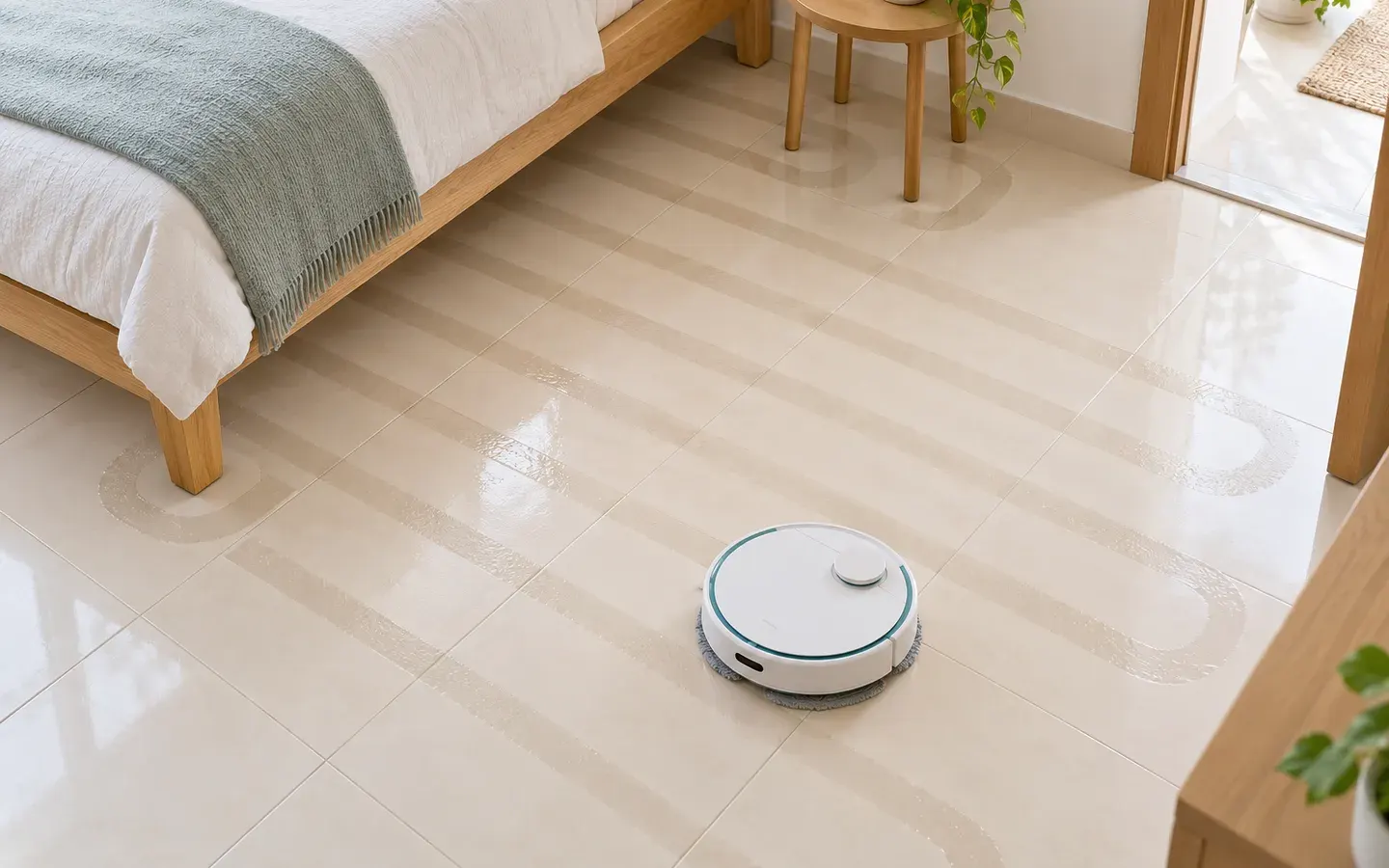 Advanced
What Path Lets a Robot Mop Cover a Whole Room?
How a mop robot covers a whole room: cells around obstacles, back-and-forth passes, a map of cleaned cells, drift correction and blocked cells.
Robotics8 min read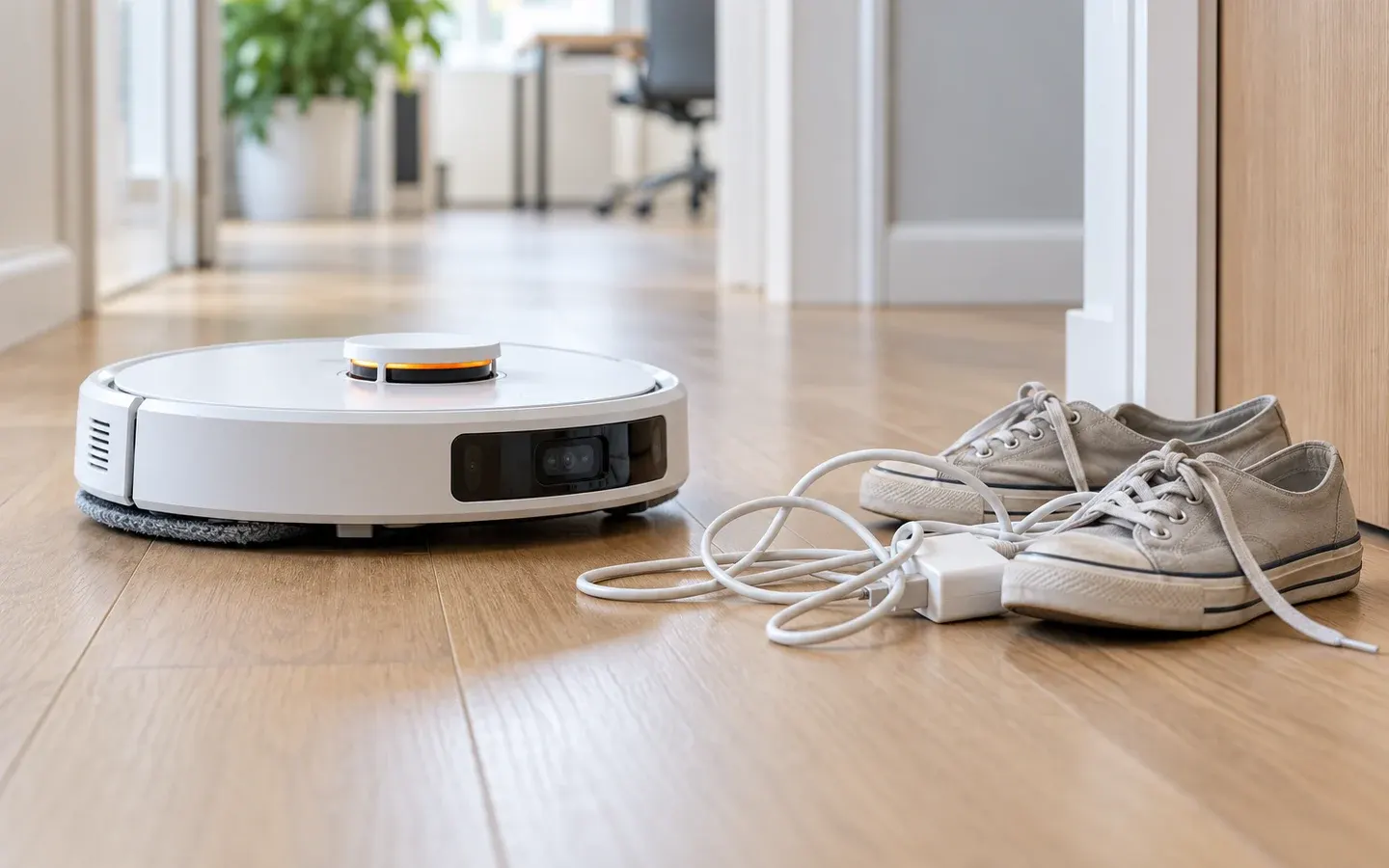 Intermediate
How Can a Mop Robot Spot Clutter and Alert a Person?
How a mop robot merges bumps, jams, unreachable cells and still frames into a clutter score per zone, then alerts a person at the right time.
Artificial intelligence7 min read Advanced
How Do Many Mop Robots Split Zones and Share a Dock?
How a fleet of mop robots splits a floor into zones, assigns one robot to each, queues for a shared dock and hands a zone over after a failure.
Robotics8 min read


Sources
These sources are written for older readers. If they feel hard, read them with an adult.
- Droplet evaporation on porous fabric materials(opens in a new tab)
PubMed CentralTier A: government, standards or research bodiesRead on November 2, 2026
- Volatile Organic Compounds' Impact on Indoor Air Quality(opens in a new tab)
U.S. EPATier A: government, standards or research bodiesRead on November 2, 2026
- Scented Products Emit a Bouquet of VOCs(opens in a new tab)
Environmental Health Perspectives (PubMed Central)Tier A: government, standards or research bodiesRead on November 2, 2026
- Improving Indoor Air Quality(opens in a new tab)
U.S. EPATier A: government, standards or research bodiesRead on November 2, 2026
- Roomba Combo 10 Max mopping, pad wash and auto-refill(opens in a new tab)
iRobotTier C: other sourcesRead on November 2, 2026
- US12232669B2 Pooling mitigation for autonomous wet cleaning robot(opens in a new tab)
Google PatentsTier C: other sourcesRead on November 2, 2026
- US8898844B1 Mopping assembly for a mobile robot(opens in a new tab)
Google PatentsTier C: other sourcesRead on November 2, 2026
- When the robot is in Auto strategy, the mopping pad plates lift on carpet(opens in a new tab)
EcovacsTier C: other sourcesRead on November 2, 2026