

How Does Optical Sorting Recognize Materials?
- Starter
- Article
- Ages 10+
- 5 min read

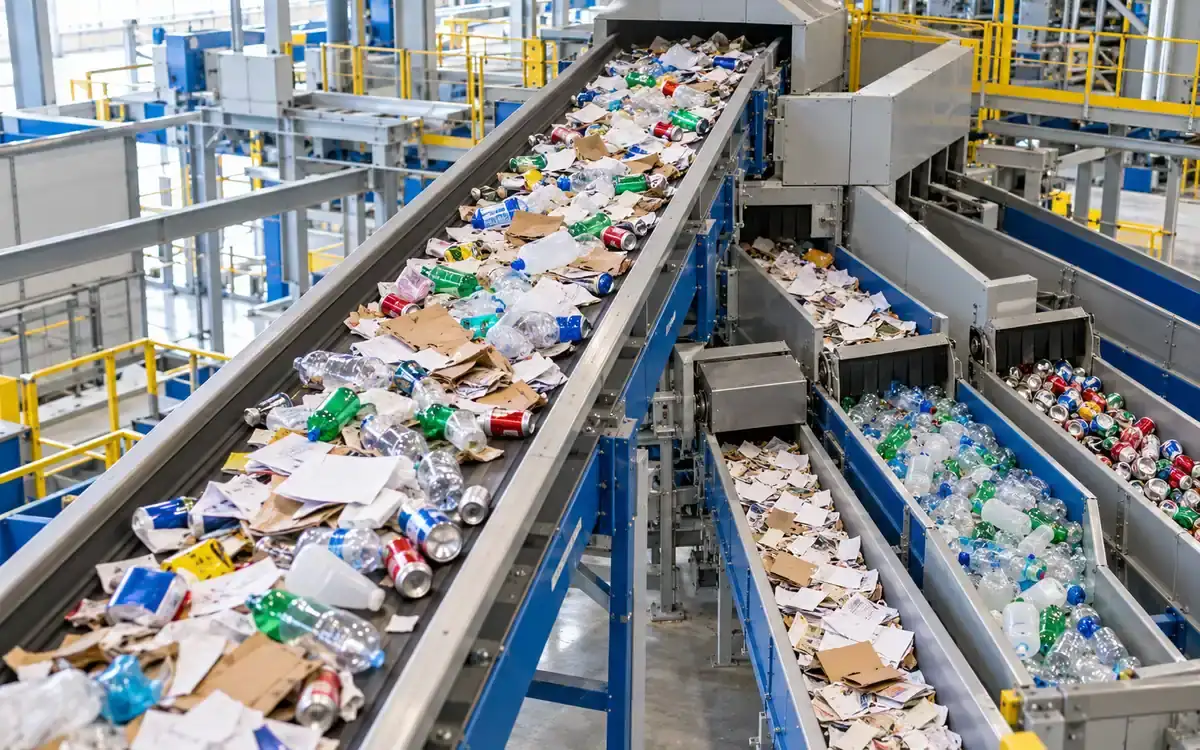
An optical sorter recognises materials with sensors and then uses air blasts to push the chosen item onto its own path. According to the Wasatch Integrated Waste Management District, the machine combines near-infrared, colour and metal sensors to identify a wide variety of materials moving on a conveyor belt. It can only recognise what its sensors can tell apart.
Contents
- Conveyor
- Sensor
- Path of the chosen item
What you will learn
- Name the kinds of sensors an optical sorter uses.
- Describe how a chosen item is separated from the belt.
- Explain why dirty or unusual items are hard for the machine to sort.
Before you start
It helps to know that flat and round items take different routes after the disc screen; this article follows the items into the optical sorter.
What does an optical sorter use to recognise materials?
It uses sensors. According to the Wasatch Integrated Waste Management District, high-resolution near-infrared (NIR), colour and metal sensors are combined to identify a wide variety of materials on a conveyor belt.
The sensor does more than check the shape of a bottle. According to NIST, a spectrometer shines infrared light on plastic and measures the reflected spectrum: how the reflected light is distributed across wavelengths. That information is used to distinguish plastic types. In plain terms, the machine reads the material's response to light instead of guessing from colour or shape alone.
Recognition and separation are successive jobs: the sensors supply information for selecting an item; the air blast at the belt exit then changes its path.
- Near-infrared sensor
- Colour sensor
- Metal sensor
How is a chosen item separated?
Air blasts push it. In this facility's description, air blasts fire at the selected items as they drop off the end of the conveyor, flicking them over a divider onto a separate path.
Items that were not selected fall straight down the normal path. Each pass gives two streams: the chosen one and the rest.
- Air nozzle
- Divider
- Chosen item
Where does the machine sit, and where does it struggle?
The facility described uses optical sorters in two places. For flat items such as paper, small cardboard and plastic film, an optical sorter helps recover film and paper for recycling. For round items, the first two optical sorters remove PET bottles (water bottles) and HDPE bottles (milk jugs and detergent bottles).
The machine has limits. According to UW Recycling, mechanised sorting equipment was built for the most common items, so it struggles with uncommon or dirty items that look like common ones.
Real-world example
Picture a PET water bottle and an HDPE milk jug riding a conveyor past an optical sorter. This is a hypothetical walk-through to follow the route. At the sorter selecting PET, an air blast sends the PET bottle to its own path while the HDPE jug continues. The next sorter selects HDPE from the remaining stream. These are successive selections, rather than one air blast separating every plastic type at once.
Common misunderstandings
An optical sorter does not see the way a person does. It relies on sensors, so a dirty or unusual item can be misjudged.
It also does not clean material. It only picks and separates; washing and processing come later.
Frequently asked questions
What sensors does an optical sorter use?
High-resolution near-infrared, colour and metal sensors.
What are the air blasts for?
To flick a chosen item over a divider as it drops off the end of the conveyor.
Which plastics do optical sorters remove?
In the facility described, the first two remove PET and HDPE bottles from the round items.
Summary
- Near-infrared, colour and metal sensors let the machine identify materials on a belt.
- Air blasts flick the chosen item over a divider onto its own path.
- The machine struggles with unusual or dirty items that resemble common ones.
Terms in this article
English and Vietnamese terms, with the meanings used here. Hover, tap or Tab to a term with a dotted underline for an explanation as you read.
- optical sortermáy phân loại quang học
- A machine that uses sensors to identify materials on a conveyor and separate the chosen item.
- near-infraredhồng ngoại gần
- The part of light just beyond red that a sensor can use to identify materials.
- air blastluồng khí
- A short burst of air used to flick an item onto another path.
- PET
- A type of plastic (polyethylene terephthalate) used for water bottles.
- HDPE
- A type of plastic (high-density polyethylene) used for milk jugs and detergent bottles.
This article is not marked as viewed
Spotted something wrong or unsafe?
Tell the administrator by email. The message already has the article title and address.
More in this topic
 Starter
How Is Waste Sorted?
Follow sorting from the point of disposal to a materials recovery facility, and understand why local acceptance rules come before bin choice.
6 min read Starter
Which Materials Can Be Recycled?
Compare paper, plastic, glass and aluminium, distinguishing technical recyclability from acceptance by a local collection programme.
5 min read Starter
What Does Source Separation Contribute?
Source separation directs recyclables into the right collection route. See why misplaced items may be lost and why local rules matter.
5 min read Starter
What Requirements Define a Clean Material Stream?
The right kind of item and clean enough, spatula-clean. See why one dirty item can affect the whole stream of recyclables.
5 min read


Sources
These sources are written for older readers. If they feel hard, read them with an adult.
- Material Recovery and Transfer Facility(opens in a new tab)
Wasatch Integrated Waste Management DistrictTier A: government, standards or research bodiesRead on November 3, 2026
- What is recycling contamination?(opens in a new tab)
University of Washington SustainabilityTier A: government, standards or research bodiesRead on November 3, 2026
- How Do Recycling Facilities Sort Different Kinds of Plastic?(opens in a new tab)
National Institute of Standards and TechnologyTier A: government, standards or research bodiesRead on November 3, 2026