

Which Metals Can Magnets Separate?
- Starter
- Article
- Ages 10+
- 5 min read

Magnets pull ferrous metals, meaning metals that contain iron such as steel, out of a stream of recyclables, because a magnet sticks to this kind of metal. Aluminium and copper are examples of nonferrous metals that an ordinary magnet does not appreciably attract, according to Sonoma County Zero Waste and Physics Van at the University of Illinois. A recovery facility therefore needs another machine for what is left.
Contents
- Conveyor
- Suspended magnet
- Steel can being lifted
- Items not pulled continue
What you will learn
- Say which metals a magnet pulls and which it leaves alone.
- Describe how a drum magnet takes ferrous metal out of a stream of material.
- Explain why aluminium cans need a different machine.
Before you start
You only need to know that recyclables ride conveyors past many machines at a recovery facility. This article covers the magnets.
Which metals does a magnet pull?
A magnet pulls ferrous metals, which are metals that contain iron. Steel is the familiar example: a steel soup can sticks to a magnet. Nonferrous metals are the group without iron, such as brass, aluminium and copper.
There is a finer point. According to a question-and-answer page from Physics Van at the University of Illinois, most familiar metals that do not contain iron are not ferromagnetic and are only very weakly attracted to or repelled by a magnet. The reverse needs care too: iron content does not automatically make a metal strongly magnetic. The same source notes that pure nickel is strongly attracted despite not being an iron-containing metal. So ferrous/nonferrous describes composition, not an absolute rule about magnetic attraction.
- Steel can pulled
- Aluminium can not pulled
- Copper bar not pulled
Where do magnets sit in the line?
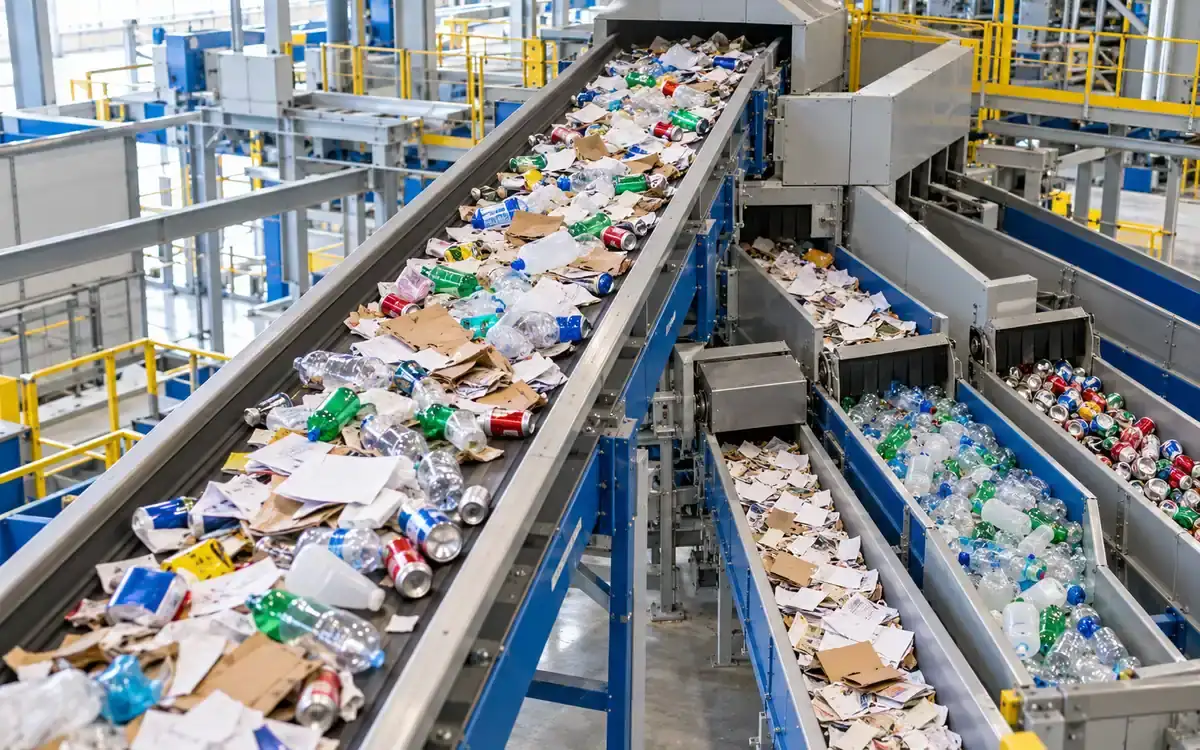
A magnet is one step in a chain of sorting machines. In the facility described by the Wasatch Integrated Waste Management District, round items, mostly containers, pass a suspended magnet that removes ferrous metal such as soup cans. What remains moves on to a machine for nonferrous metal.
The same page also illustrates a drum-magnet mechanism. The next section explains that mechanism; the two descriptions alone do not establish that the facility has two separate magnetic machines.
How does a drum magnet work?
A drum magnet houses powerful permanent magnets inside a rotating drum. Material passes close to the drum; ferrous metal is attracted and sticks to it, while other items do not.
The drum keeps turning and carries the ferrous metal over. Where it is no longer held, it drops into a separate chute. The rest of the material takes another route. The stream splits in two: one side with the ferrous metal, the other with less ferrous metal.
- Rotating drum
- Fixed magnet inside
- Chute for ferrous metal
- Chute for the rest
What is left after the magnet?
What the magnet does not pull is left, and that includes aluminium cans. Aluminium is a nonferrous metal, so the magnet ignores it. In the same chain, an eddy-current separator for nonferrous metal comes after the magnet and removes the aluminium cans. How that machine works is the subject of the next article.
Real-world example
Picture two cans riding a conveyor: a steel soup can and an aluminium drink can. This is a hypothetical walk-through; real equipment differs between facilities.
When they reach the magnet, the steel can is pulled up and lifted off the belt. The aluminium can is not pulled and travels on. A machine further down takes the aluminium out.
Common misunderstandings
A magnet does not pull every metal. It pulls ferrous metal; aluminium, copper and brass contain no iron, so the magnet ignores them.
Containing iron does not mean being pulled hard. A metal with only some iron is not automatically ferromagnetic, so a magnet is a useful test but not a perfect one.
A magnet cannot pull aluminium cans out of the waste stream. That job belongs to the eddy-current separator.
Frequently asked questions
Does a magnet attract an aluminium can?
Not to any useful degree. Aluminium does not contain iron, and most familiar metals of this kind are only very weakly attracted to or repelled by a magnet.
Why does a drum magnet have to rotate?
Because the turning drum carries the ferrous metal over and drops it into a separate chute, away from the rest of the material.
What kind of magnet is used in a sorting machine?
In the facility described, powerful permanent magnets sit inside a rotating drum.
Summary
- A magnet pulls ferrous metal, which contains iron such as steel, and ignores nonferrous metal such as aluminium.
- A drum magnet pulls ferrous metal out, carries it over and drops it into a separate chute.
- Aluminium cans move on to the eddy-current separator.
Terms in this article
English and Vietnamese terms, with the meanings used here. Hover, tap or Tab to a term with a dotted underline for an explanation as you read.
- ferrous metalkim loại đen
- A metal containing iron, such as steel; common can-sorting examples are attracted by magnets, though iron content does not guarantee strong attraction for every alloy.
- nonferrous metalkim loại màu
- A metal that does not contain iron, such as aluminium, copper and brass.
- drum magnettrống nam châm
- A rotating drum with permanent magnets inside that pulls ferrous metal out of a stream of material.
- permanent magnetnam châm vĩnh cửu
- A magnet that keeps its magnetism on its own, without electric current.
- eddy-current separatormáy tách dòng xoáy
- A machine that separates nonferrous metals such as aluminium from a stream of material using an alternating magnetic field.
This article is not marked as viewed
Spotted something wrong or unsafe?
Tell the administrator by email. The message already has the article title and address.
More in this topic
 Starter
How Is Waste Sorted?
Follow sorting from the point of disposal to a materials recovery facility, and understand why local acceptance rules come before bin choice.
6 min read Starter
Which Materials Can Be Recycled?
Compare paper, plastic, glass and aluminium, distinguishing technical recyclability from acceptance by a local collection programme.
5 min read Starter
What Does Source Separation Contribute?
Source separation directs recyclables into the right collection route. See why misplaced items may be lost and why local rules matter.
5 min read Starter
What Requirements Define a Clean Material Stream?
The right kind of item and clean enough, spatula-clean. See why one dirty item can affect the whole stream of recyclables.
5 min read


Sources
These sources are written for older readers. If they feel hard, read them with an adult.
- Material Recovery and Transfer Facility(opens in a new tab)
Wasatch Integrated Waste Management DistrictTier A: government, standards or research bodiesRead on November 3, 2026
- Metal - scrap(opens in a new tab)
Sonoma County Zero WasteTier A: government, standards or research bodiesRead on November 3, 2026
- Magnets and Iron(opens in a new tab)
Physics Van, University of IllinoisTier A: government, standards or research bodiesRead on November 3, 2026