

How Do Conveyors and Screens Separate Materials?
- Starter
- Article
- Ages 10+
- 5 min read

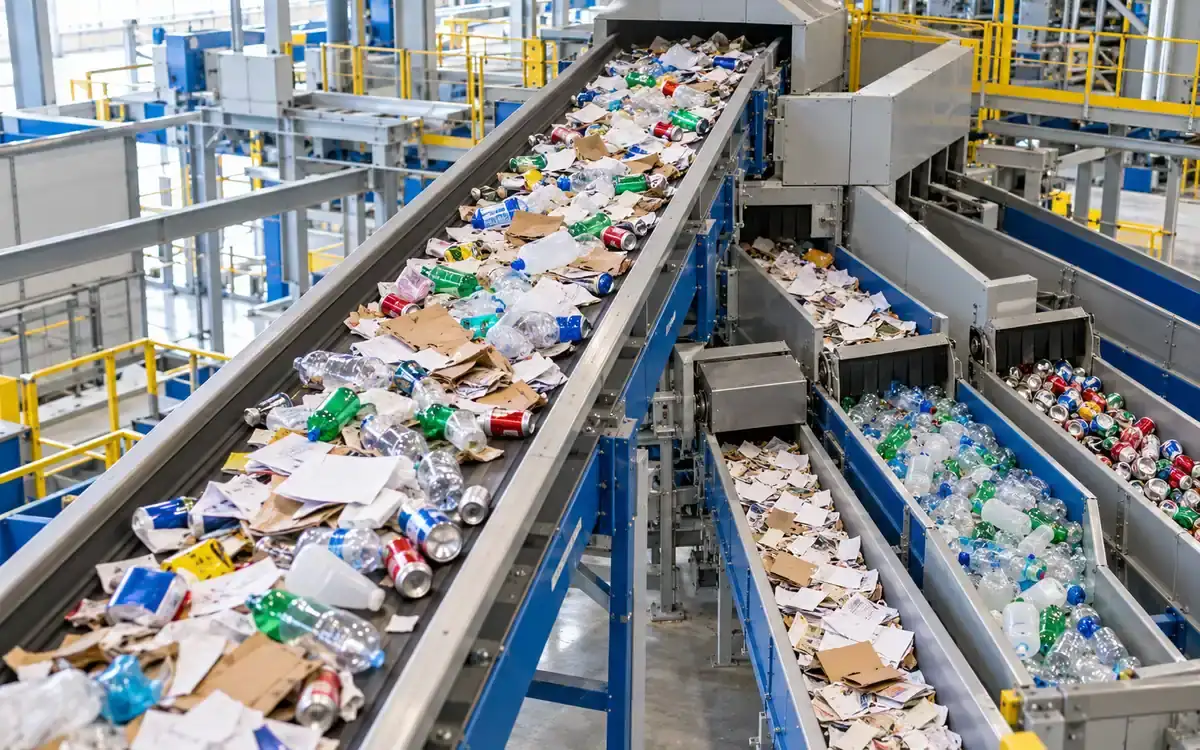
A conveyor carries recyclables steadily from machine to machine, and screens split them first by size and then by shape. In the recovery facility described by the Wasatch Integrated Waste Management District, a rotary screen removes oversize pieces and tears bags open, and a disc screen separates flat items from round ones. Machines further down the line identify the material.
Contents
- Conveyor feeding material in
- Rotary screen: splits by size
- Disc screen: splits by shape
- Route of flat items
- Route of round items
What you will learn
- Say what the conveyors do before any screening and what they clear out first.
- Explain how a rotary screen separates materials by size.
- Tell flat items from round ones at the disc screen and say where each goes next.
Before you start
You only need to know that collected recyclables travel to a recovery facility, where, according to the US EPA, materials are sorted, cleaned and processed. This article covers the machine sorting that happens there. It follows one specific facility; other facilities may arrange their machines differently.
What do the conveyors do before the screens?
The infeed conveyor feeds material into the system at a uniform, metered rate, so the machines downstream get a steady flow instead of sudden heaps.
From there the material runs along the presort conveyor. Sorters on each side pull off what should not go further. Large clean cardboard is taken out for recycling on its own, together with bulky metal such as pots and pans. Items the system cannot process, such as hoses, wire, electronics, carpets, tires and textiles, are removed too, so they do not jam the line or damage equipment downstream.
The sorters also try to open bags. Even so, recyclables left inside bags are likely not to be recovered.
- Infeed conveyor
- Bin for large clean cardboard
- Bin for items that cannot be processed
How does a rotary screen separate by size?
A rotary screen, called a trommel, is a turning drum with holes: material larger than the holes is held back and leaves separately, while the smaller part moves on. In the facility described, the first trommel has large holes and removes the oversize fraction.
Fixed metal spikes inside the drum rip bags open and free pieces that are stuck together, so each item can land where it belongs when screened.
What passes through goes to a second trommel. It also has spikes, but its holes are smaller. The result is a middle fraction: smaller than the first screen's holes and larger than the second's.
- Rotary drum with holes
- Metal spikes inside
- Oversize part leaving at the end
- Small part falling through the holes
How does a disc screen separate by shape?
The disc screen splits the middle fraction by shape: flat items on one side, round items on the other. The rotary screens only know large from small; the disc screen adds a second test.
Flat items, such as paper, small cardboard and plastic film, go to an optical sorter. Round items, mostly containers such as bottles and cans, pass through a series of other machines. The next articles in this topic cover each machine in that series.
- Conveyor bringing in middle-sized material
- Disc screen
- Route of flat items
- Optical sorter
- Route of round items
Real-world example
Picture three items entering the line: a large clean cardboard box, a newspaper and a water bottle. This is a hypothetical walk-through to follow the route; real equipment differs from one facility to another.
The cardboard box is pulled off at the presort conveyor and recycled on its own. Assume the newspaper and bottle are smaller than the first screen's holes but larger than the second screen's holes: they belong to the middle fraction sent to the disc screen. Being smaller than the first screen's holes alone does not tell us whether an item reaches the disc screen. There the flat newspaper turns toward the optical sorter. The round bottle turns toward the series of machines for round items.
Common misunderstandings
Screens do not recognise materials. They only divide by size and shape. It is the optical sorter that uses sensors to identify a wide variety of materials moving on a conveyor belt.
Putting items in a closed bag does not help the machines. The spikes in the rotary screen can tear a bag, but recyclables left inside bags are still likely not to be recovered.
Frequently asked questions
What is a trommel?
It is a turning drum-shaped screen with metal spikes inside. It rips bags open, frees pieces from each other and removes the part larger than its holes.
Why separate flat items from round ones?
Because the two kinds take different routes. Flat items go to an optical sorter, while round items, mostly containers, pass through a series of equipment.
Are recyclables inside a bag processed?
Probably not. The facility described says recyclables left inside bags are likely not to be recovered.
Summary
- The infeed conveyor feeds material evenly, and the presort conveyor clears large and unprocessable items.
- Rotary screens tear bags open and remove oversize pieces; the second one leaves a middle fraction.
- The disc screen separates flat from round, and each goes to its own row of machines.
Terms in this article
English and Vietnamese terms, with the meanings used here. Hover, tap or Tab to a term with a dotted underline for an explanation as you read.
- conveyorbăng tải
- A moving belt that carries material from one machine to the next.
- trommelsàng quay
- A rotary screen with metal spikes inside that rips bags open and removes the part larger than its holes.
- disc screensàng đĩa
- A machine that separates middle-sized material by shape, flat or round.
- optical sortermáy phân loại quang học
- A machine that uses sensors to identify materials moving on a conveyor belt.
- recovery facilitycơ sở thu hồi
- A facility where collected recyclables are sorted, cleaned and processed.
This article is not marked as viewed
Spotted something wrong or unsafe?
Tell the administrator by email. The message already has the article title and address.
More in this topic
 Starter
How Is Waste Sorted?
Follow sorting from the point of disposal to a materials recovery facility, and understand why local acceptance rules come before bin choice.
6 min read Starter
Which Materials Can Be Recycled?
Compare paper, plastic, glass and aluminium, distinguishing technical recyclability from acceptance by a local collection programme.
5 min read Starter
What Does Source Separation Contribute?
Source separation directs recyclables into the right collection route. See why misplaced items may be lost and why local rules matter.
5 min read Starter
What Requirements Define a Clean Material Stream?
The right kind of item and clean enough, spatula-clean. See why one dirty item can affect the whole stream of recyclables.
5 min read


Sources
These sources are written for older readers. If they feel hard, read them with an adult.
- Material Recovery and Transfer Facility(opens in a new tab)
Wasatch Integrated Waste Management DistrictTier A: government, standards or research bodiesRead on November 3, 2026
- Recycling Basics and Benefits(opens in a new tab)
US EPATier A: government, standards or research bodiesRead on November 3, 2026